



The "Great Van Gogh Exhibition: Café Terrace at Night," which has attracted considerable attention due to the first visit to Japan in approximately 20 years of Vincent van Gogh's (1853-1890) masterpiece "Café Terrace at Night (Place de la Forum)," is currently being held at the Ueno Royal Museum. The exhibition runs until August 12, 2026 (Wednesday).
The Kröller-Müller Museum in the Netherlands boasts one of the world's leading collections of Van Gogh's works. This exhibition, comprised solely of his finest pieces, is the first of two phases of the "Great Van Gogh Exhibition," focusing on the first half of his short artistic career, which spanned only about 10 years.
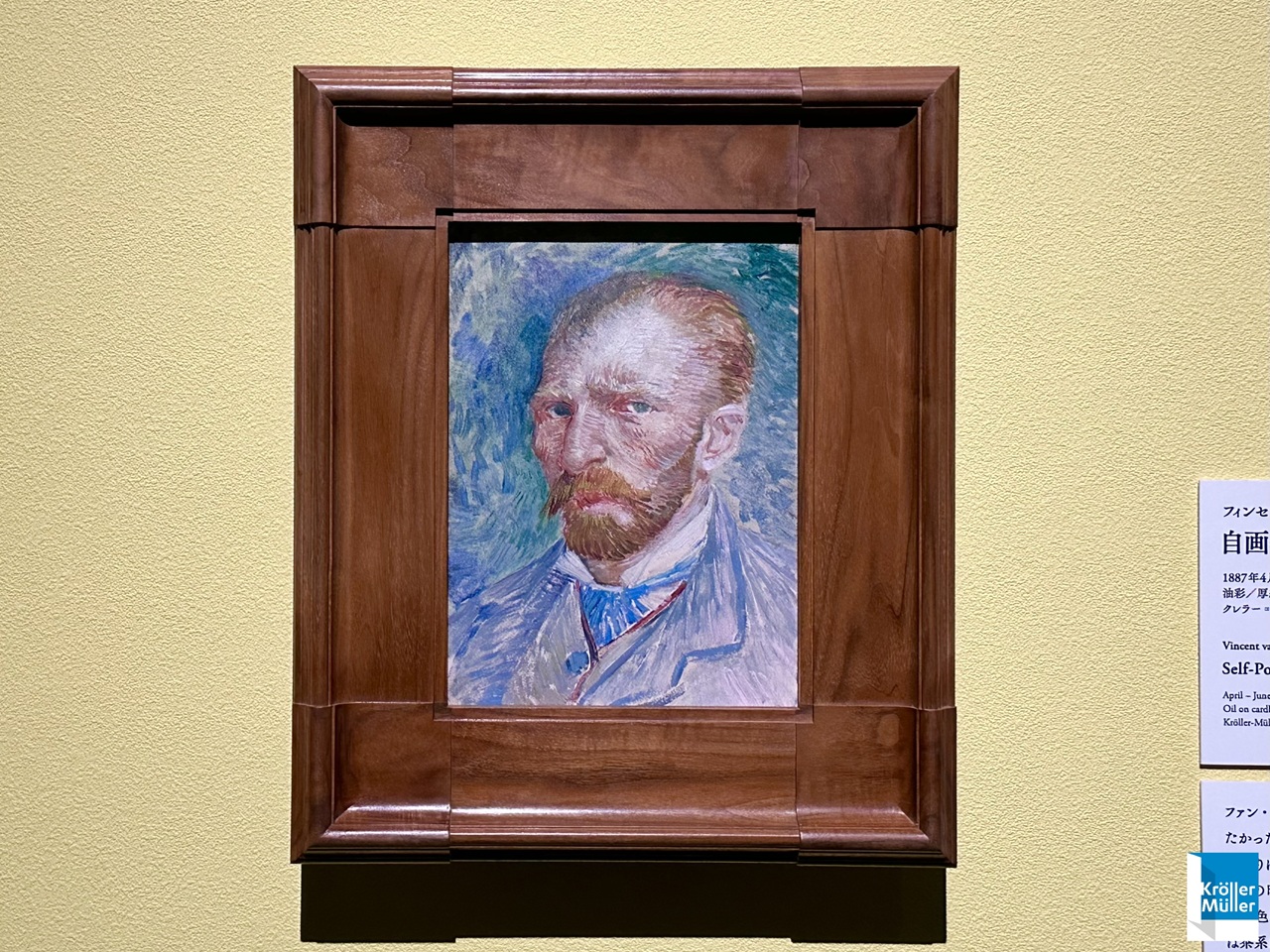
Vincent van Gogh, *Self-Portrait*, April-June 1887, Kröller-Müller Museum © Collection Kröller-Müller Museum, Otterlo, the Netherlands.
The exhibition features approximately 60 works by Van Gogh, including oil paintings and drawings, alongside works by other leading contemporary painters such as Monet and Renoir . The five-chapter exhibition traces the trajectory of Van Gogh's life, from his early time in the Netherlands, his awakening to vibrant colors in Paris, his subsequent move to Arles in southern France in search of even greater light, and the culmination of his masterpiece, "Café Terrace at Night (Place de la Forum)."
Another highlight is the numerous quotes from letters she wrote to her brother Theo and close acquaintances, which are displayed on the walls and explanatory panels of the venue, serving as clues to understanding her feelings.
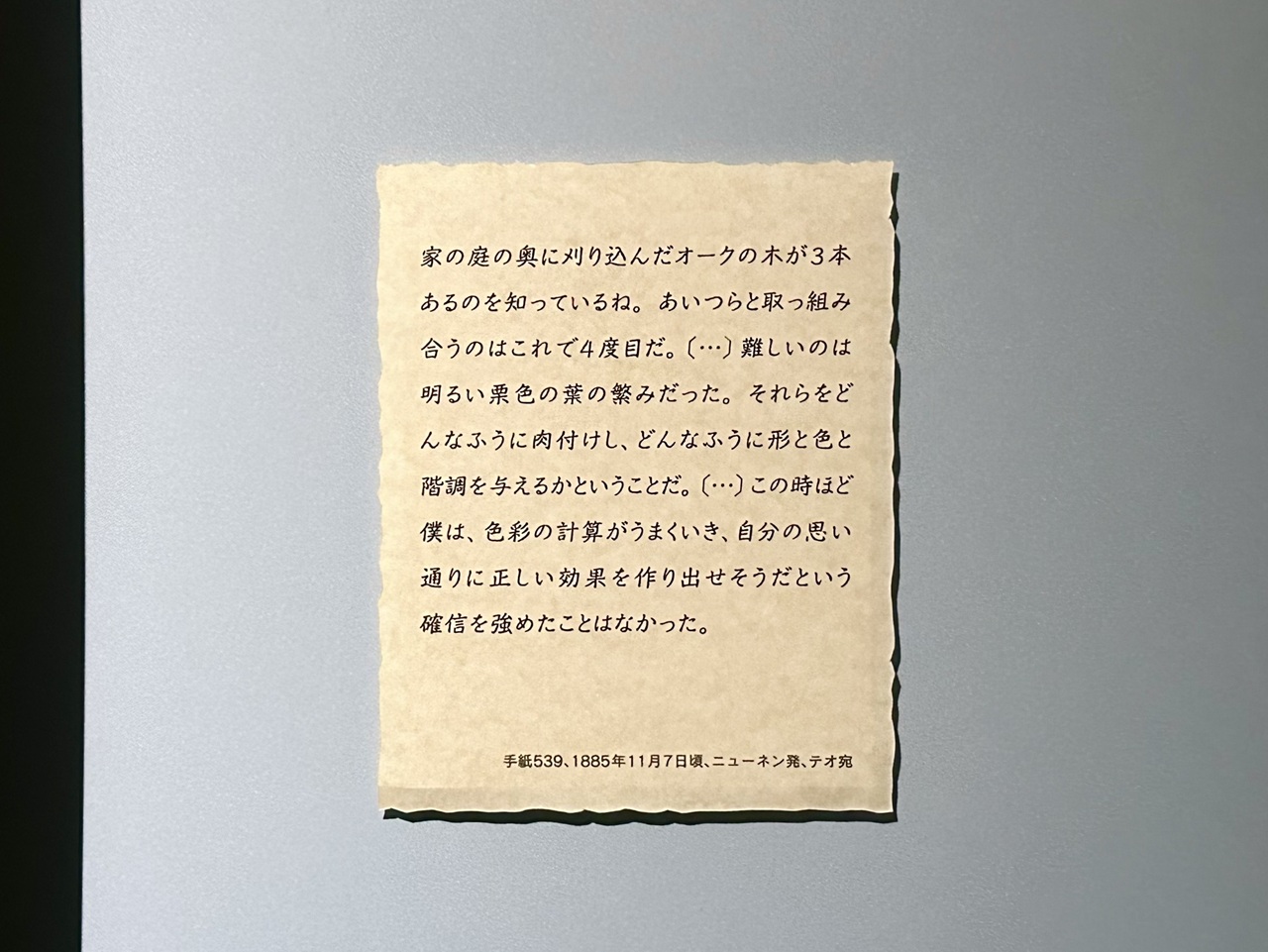
Exhibition view of "The Great Van Gogh Exhibition: Cafe Terrace at Night," Ueno Royal Museum, 2026.
Chapter 1: "The Barbizon School and the Hague School"
In 1869, at the age of 16, Van Gogh began working at the Goupil Gallery, which was owned by his uncle. However, as his interest in religious issues deepened, he lost interest in the art trade and was dismissed in 1876. After that, he aspired to become a pastor, and through his interactions with farmers and laborers living in harsh conditions, he came to believe that "truth" and "sincerity" could be found in their lives.
When he began his career as a painter in earnest after 1880, the first things that caught his interest were the French "Barbizon School" and the Dutch "Hague School," which are introduced in Chapter 1.
The Barbizon School was a group known for their naturalistic landscape and genre paintings, active in and around the village of Barbizon on the outskirts of Paris from the first half to the mid-19th century. Moving away from traditional historical painting, they realistically depicted familiar nature and the lives of poor farmers based on direct observation. Their outdoor painting style, outside the studio, had a significant influence on the next generation of Impressionists.
On the other hand, the Hague School, which was active in the latter half of the 19th century in The Hague, a city on the North Sea in the Netherlands, studied under the Barbizon School and painted subjects that were unusual at the time, such as the harsh life scenes of fishing villages. Their unique technique, which emphasized light and shadow over color and captured damp air and cloudy skies with grayish tones that evoked melancholy and emotion, gained widespread support in the Dutch art world at the time.
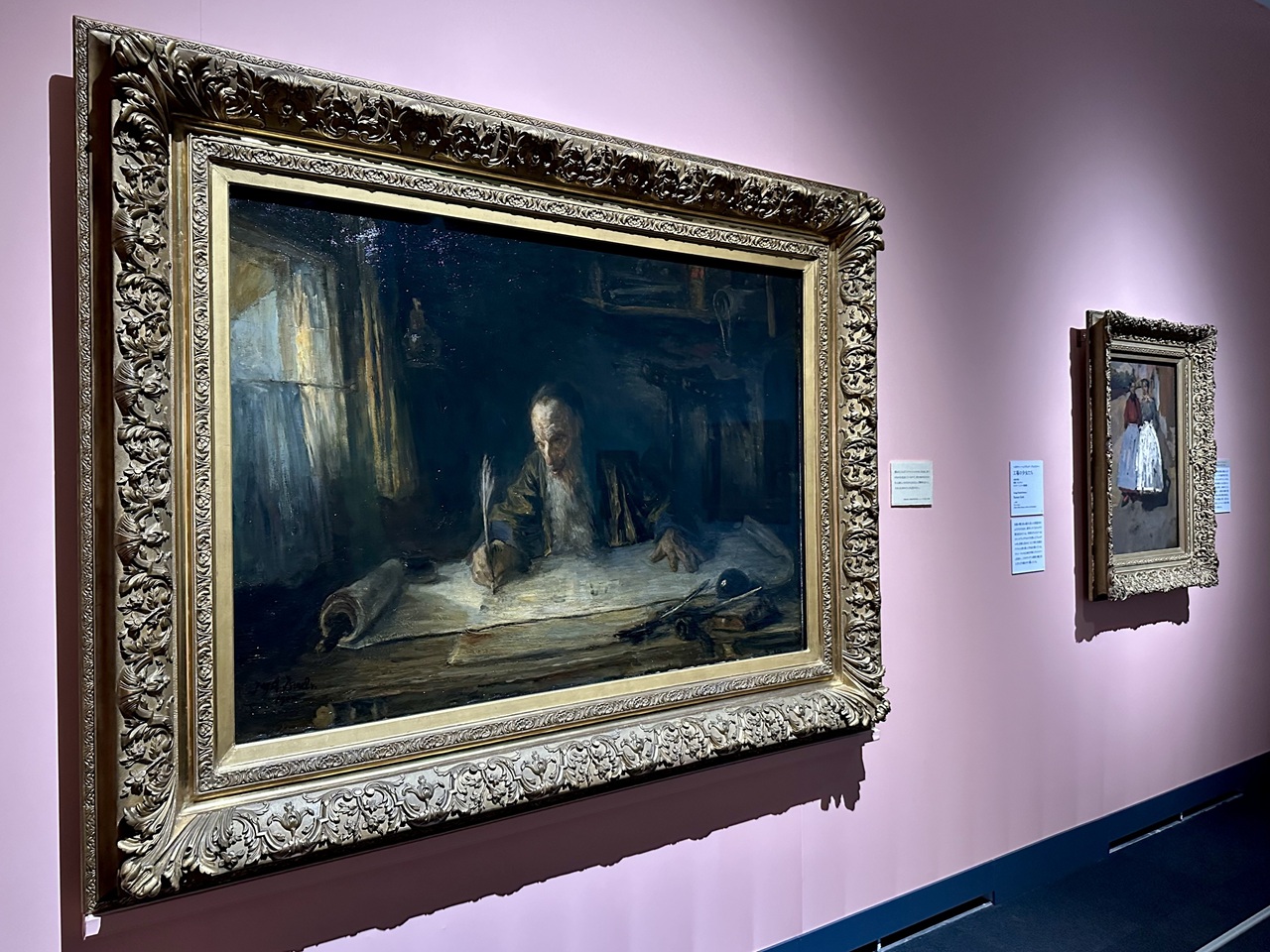
Exhibition view; on the left is Josef Israels' "The Jewish Manuscript Scribe," 1902, Kröller-Müller Museum.
Van Gogh began by copying instructional books, and from the end of 1881 to September 1883, he was based in The Hague, where he learned the fundamentals of painting directly from Anton Mauve, a distant relative and member of the Hague School. His main role model was Josef Israëls, a central figure in the school.
Israël painted not only genre subjects of fishermen and farmers, but also many religious themes with a Jewish background. His dramatic use of chiaroscuro was inherited from the 17th-century Dutch master Rembrandt. In Van Gogh's early masterpiece, "The Potato Eaters" (in the Van Gogh Museum), the influence of Israël can be seen in the solemn religious atmosphere in which the figures' faces emerge from the darkness. (A lithograph of this work is on display at the venue.)
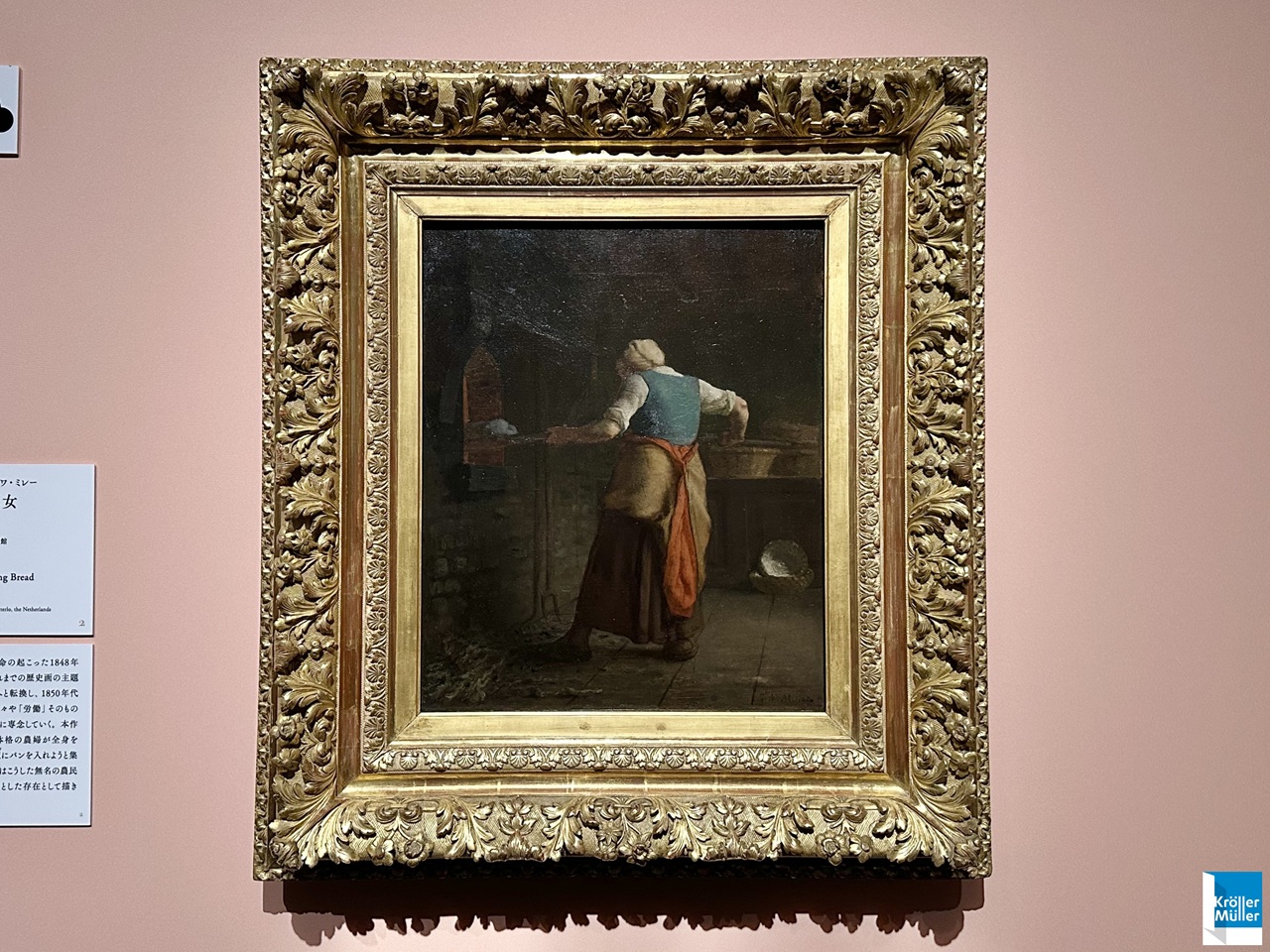
Jean-François Millet, *The Breadmaker*, 1854, Kröller-Müller Museum © Collection Kröller-Müller Museum, Otterlo, the Netherlands.
Furthermore, when discussing Van Gogh, the presence of Jean-François Millet, a member of the Barbizon School known for works such as "The Sower" and "The Gleaners," is indispensable. Van Gogh admired Millet throughout his life for capturing people who lived devout lives in harmony with the earth with a solemn gaze, and depicting the sublimity of their way of life. He did not merely copy lithographs, but reconstructed them with his own colors and expressions, using them as the foundation for establishing his own style.
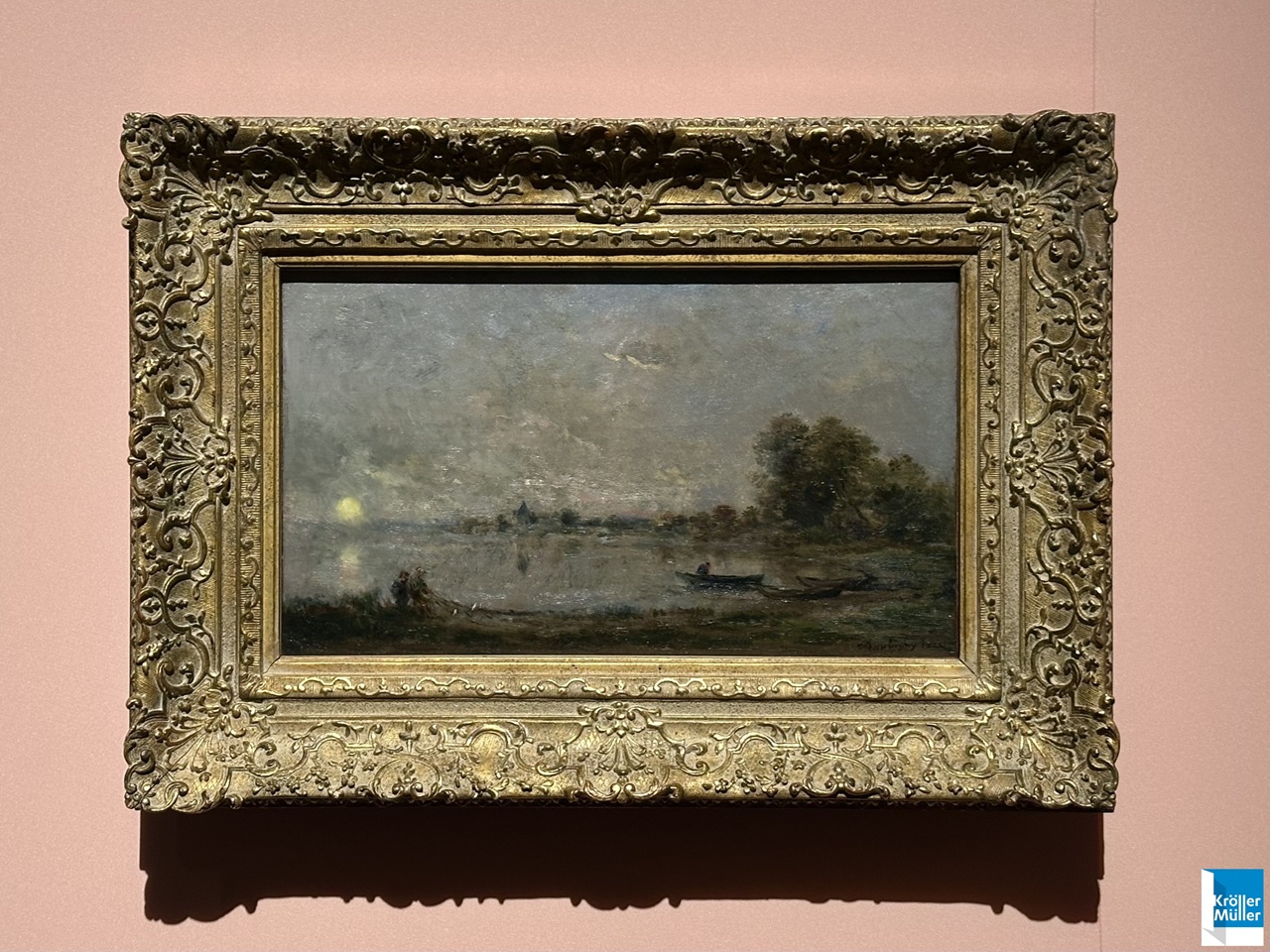
Charles-François Daubigny, *The River at Sunset*, 1873, Kröller-Müller Museum © Collection Kröller-Müller Museum, Otterlo, the Netherlands.
Chapter 2: "The Dutch Period"
Chapter 2 features oil paintings and drawings that Van Gogh actually produced in The Hague and in Nuenen, in southern Holland, where he moved in 1883.
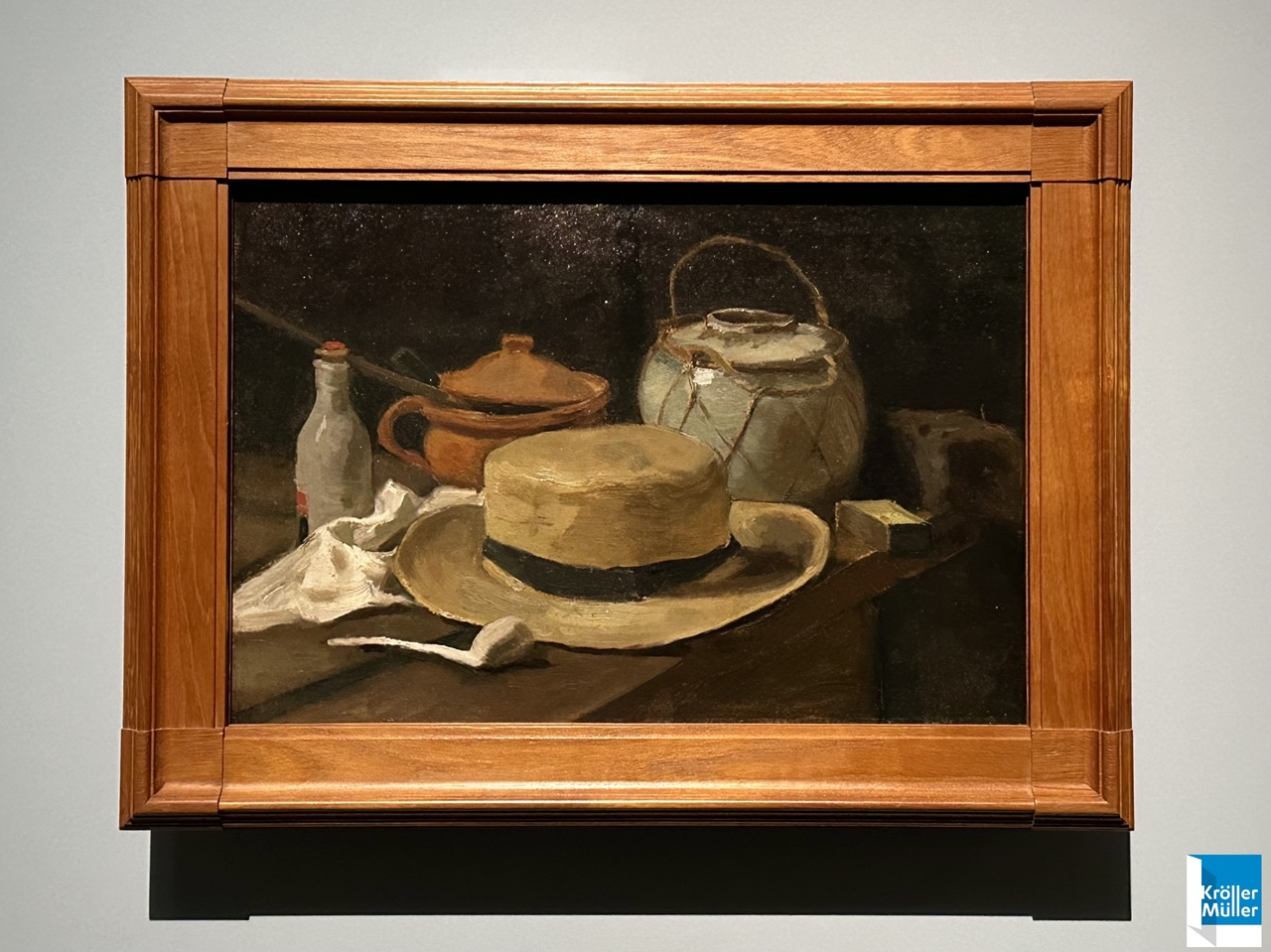
Vincent van Gogh, *Still Life with Straw Hat*, late November – mid-December 1881, Kröller-Müller Museum © Collection Kröller-Müller Museum, Otterlo, the Netherlands.
"Still Life with Straw Hat" (1881) marks the period when Van Gogh, who had previously devoted himself entirely to drawing, began to seriously grapple with oil painting. study On a wooden table, he arranged a yellow straw hat with a black ribbon, a pipe, pottery, and scraps of cloth, attempting to depict a variety of textures. His pride is evident in the letter he wrote, "I think I've reached the first step towards starting to paint something truly serious." It is said that he kept this work for a long time as reference material for his later creations.
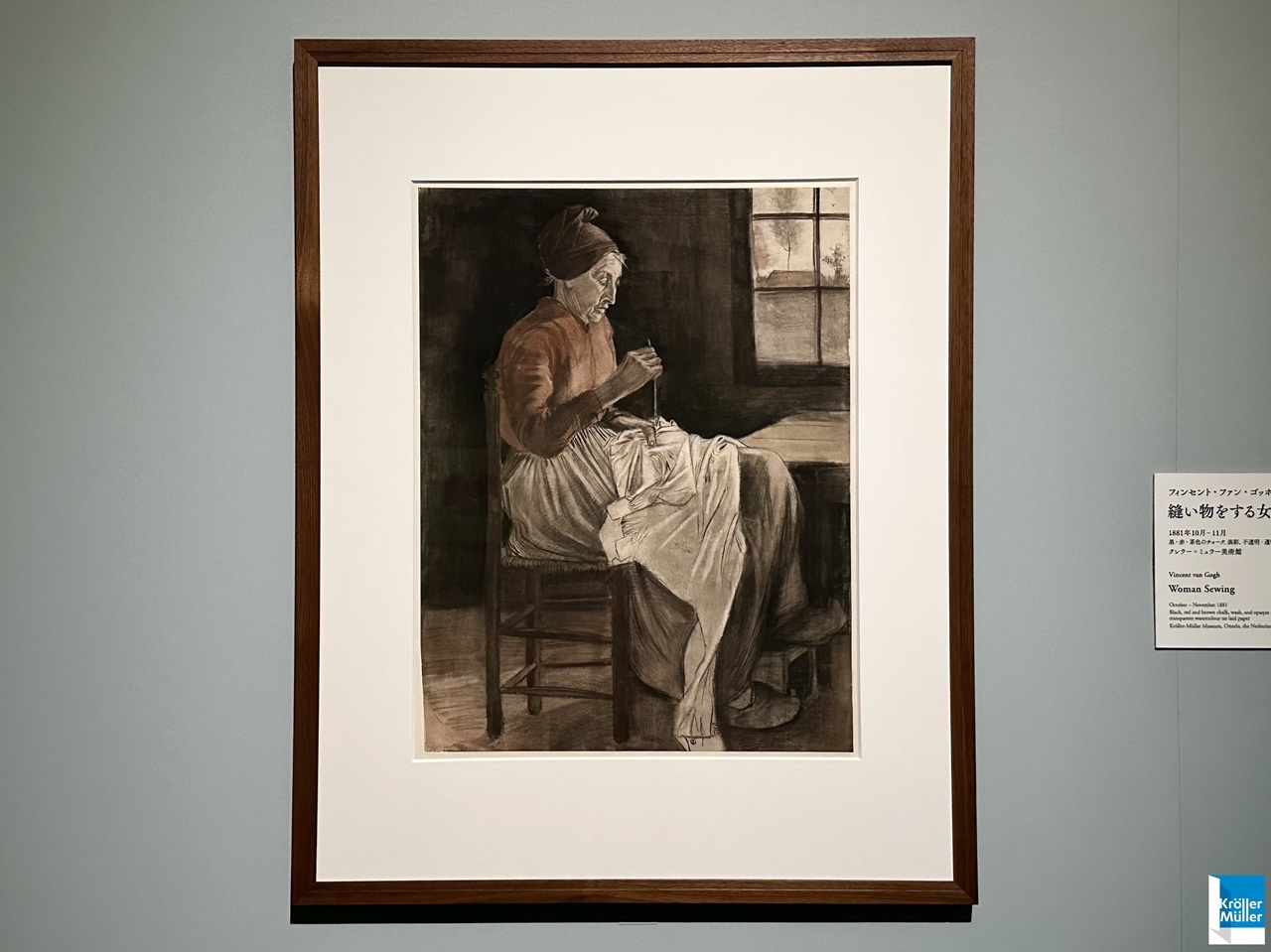
Vincent van Gogh, *Woman Sewing*, October–November 1881, Kröller-Müller Museum © Collection Kröller-Müller Museum, Otterlo, the Netherlands.
While both the Hague School and Van Gogh depicted the lives of the working class, the Hague School tended to portray the "modest life" that bourgeois collectors fantasized about, in order to win their favor. Van Gogh, on the other hand, showed his unique style by sometimes exaggerating faces to portray their suffering and struggles as harsh, ugly, or exhausted.
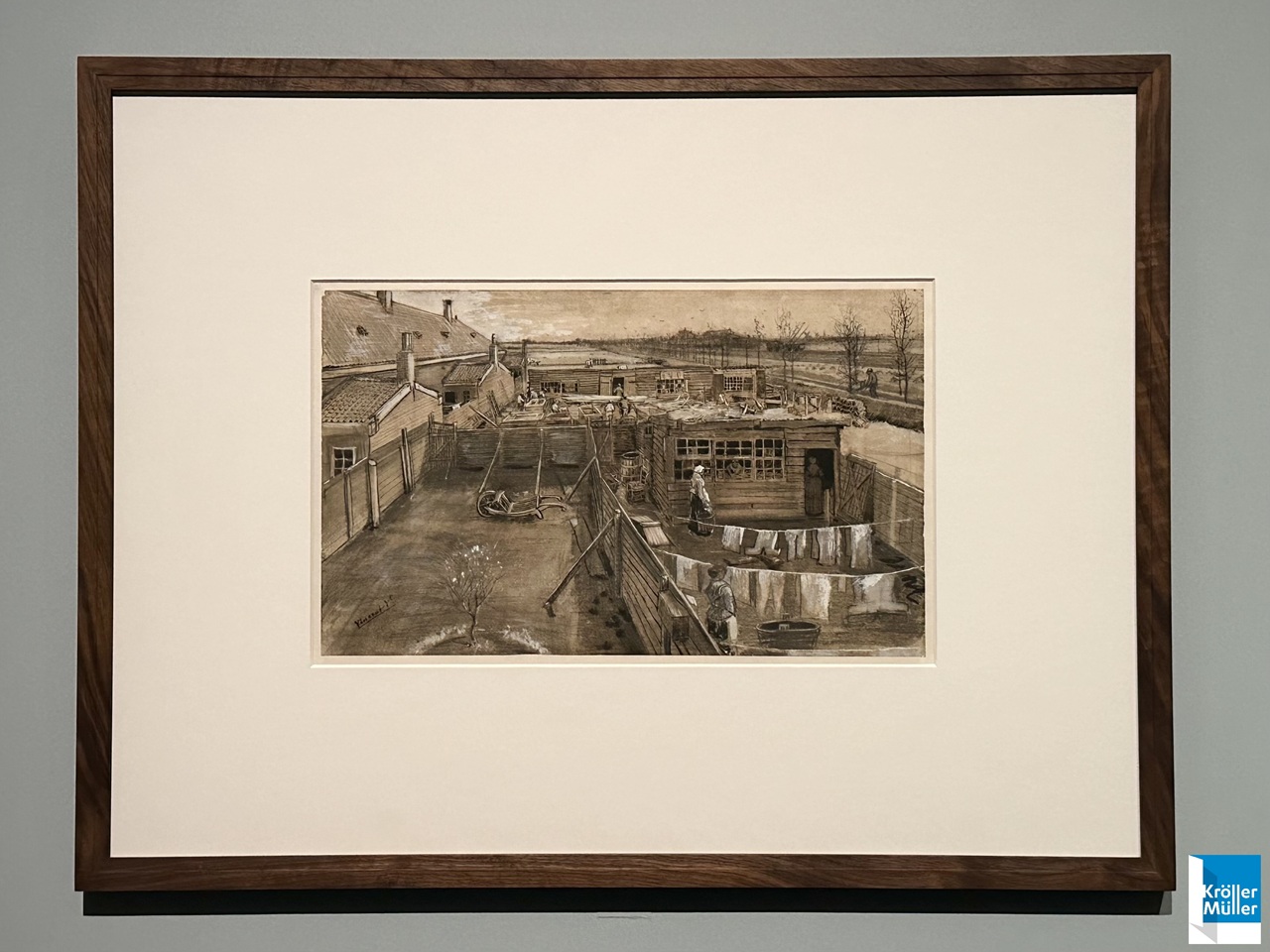
Vincent van Gogh, *The Carpenter's Workshop and Laundry*, late May 1882, Kröller-Müller Museum © Collection Kröller-Müller Museum, Otterlo, the Netherlands.
"The Carpenter's Workshop and Laundry Room" (1882), a view of the back of his home in The Hague, uses perspective to create a sense of realism. Of particular note is the small tree depicted in the foreground. He initially sketched it in pencil, then outlined it with pen and ink, added flowers with white watercolor paint, and finally scratched the edges of the background with a sharp tool. While it retains a slight awkwardness, this work reveals the artist's struggle to expand his expressive abilities by experimenting with various materials and techniques.
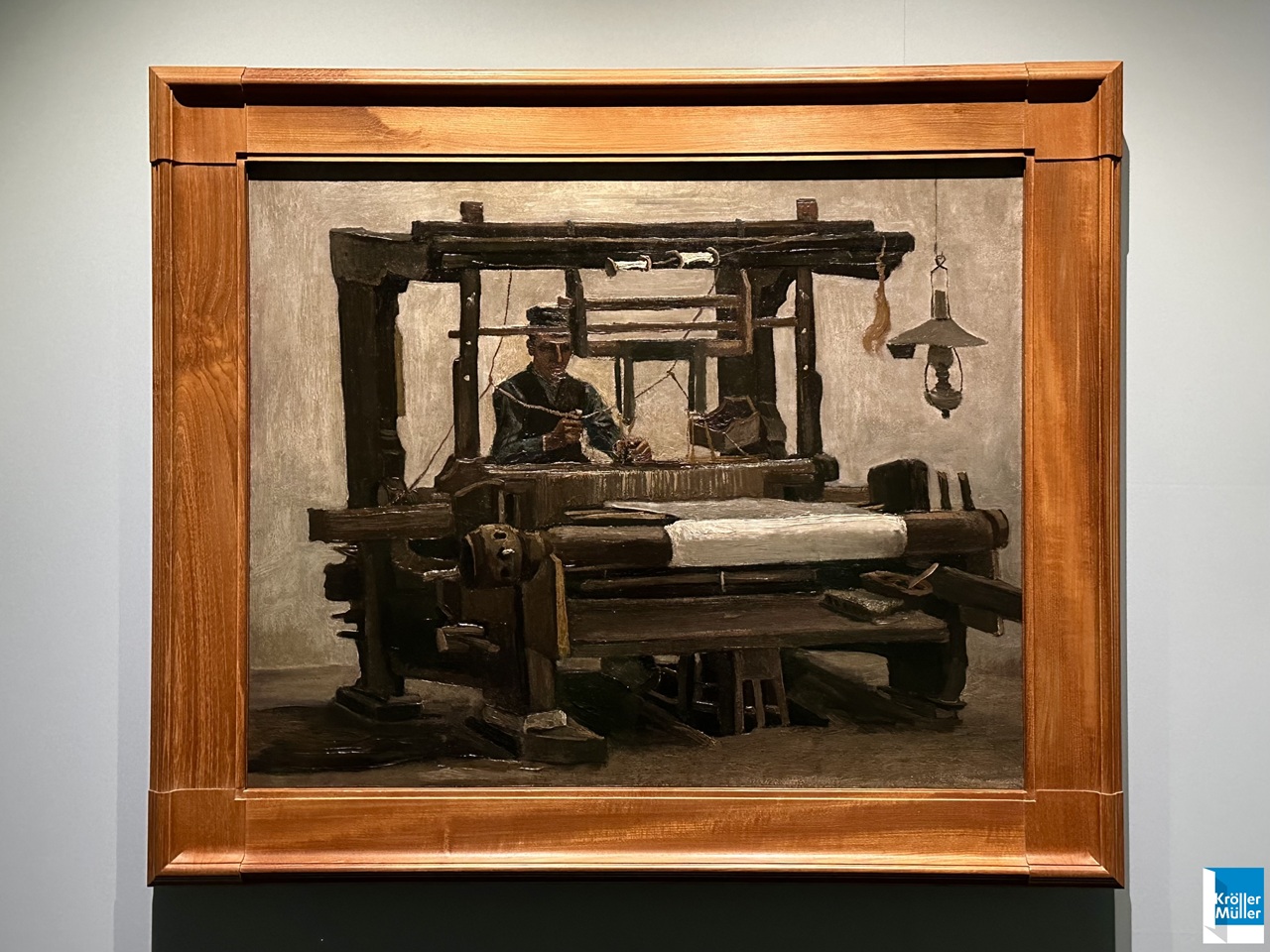
Vincent van Gogh, *The Loom and the Weaver*, April–May 1884, Kröller-Müller Museum © Collection Kröller-Müller Museum, Otterlo, the Netherlands.
Weavers at work were one of the representative motifs of the Nuenen era. When Van Gogh visited weaver villages in northern France in 1880, he was deeply moved by the weavers, whom he described as "dreamy, pensive, and like sleepwalkers." He decided to shine a spotlight on them, who were rarely featured as art motifs at the time, and he was also fascinated by the intricate structure of the looms themselves.
"The Loom and Weaver" (1884), with its imposing black loom standing out against a dull gray background, is a prime example of this style. It is said that he had this work photographed as a carte de visite (business card-sized photograph), perhaps to report the result to Theo and to promote the work.
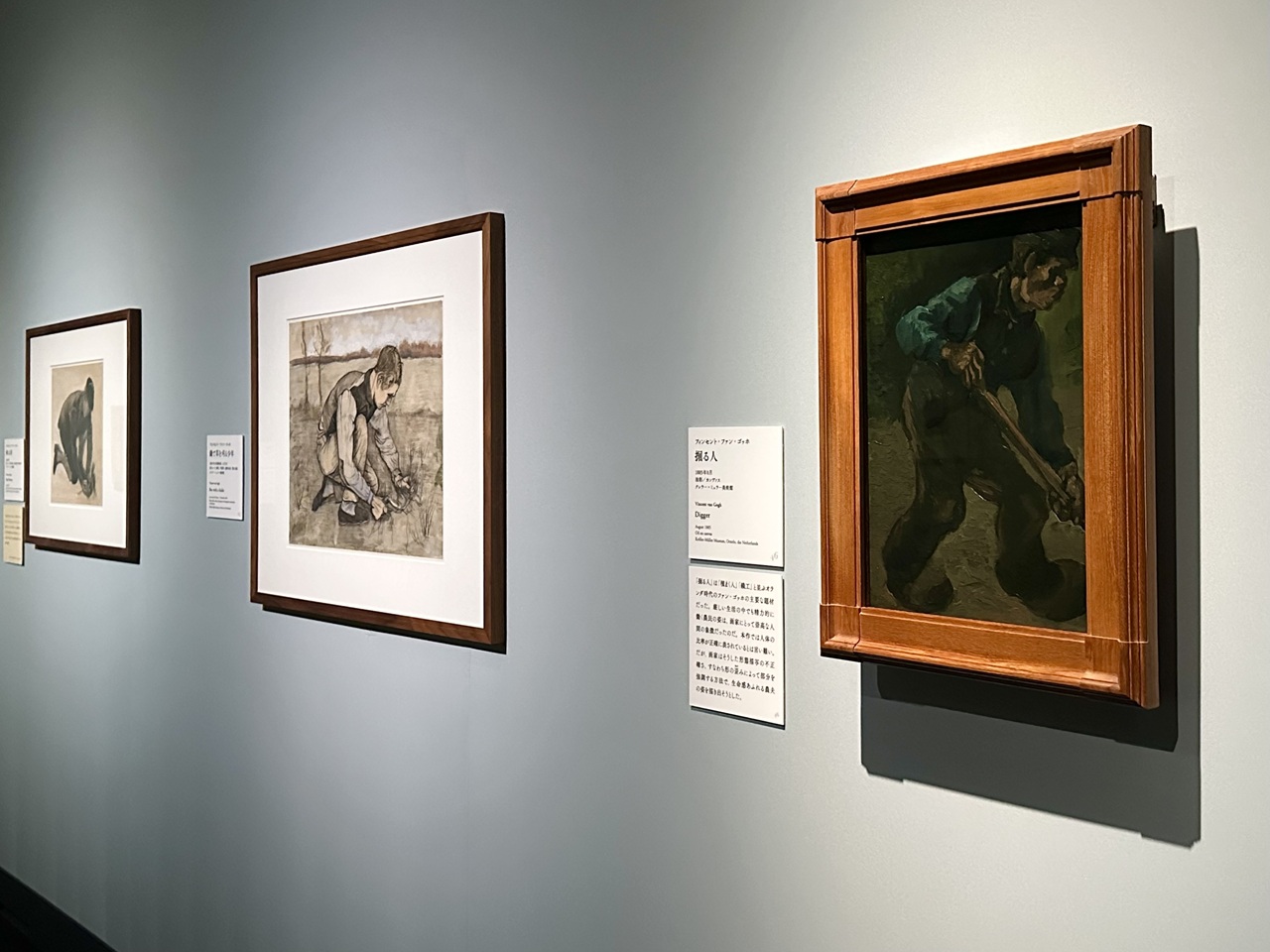
Exhibition view; on the right is Vincent van Gogh's "The Digger," August 1885, Kröller-Müller Museum.
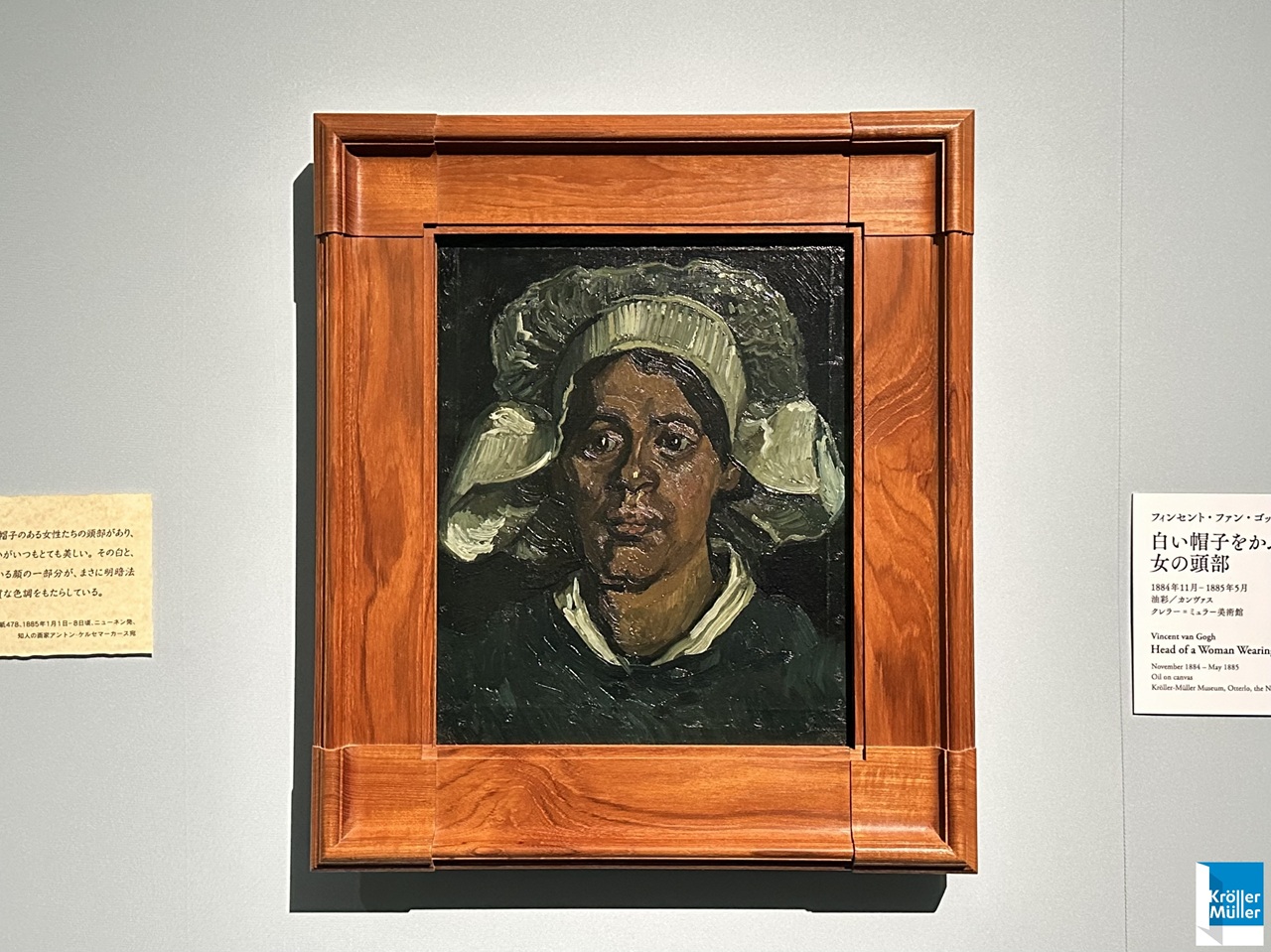
Vincent van Gogh, *Head of a Woman with a White Hat*, November 1884 – May 1885, Kröller-Müller Museum © Collection Kröller-Müller Museum, Otterlo, the Netherlands.
Between December 1883 and November 1885, while living in Nuenen, he produced over 500 works, many of which were head studies exploring chiaroscuro techniques. He was particularly interested in the white hats that the women of Nuenen wore daily, noting in a letter that the hats and the faces they cast in shadow "brought about a finer quality of color, much like chiaroscuro."
At the time, influenced by Israël, Van Gogh found beauty in "light emerging from darkness." Therefore, he adjusted the tones of the model's face and clothing, and then adjusted the light and shadow of the background to express the effect of light and depth within a dark color scheme.
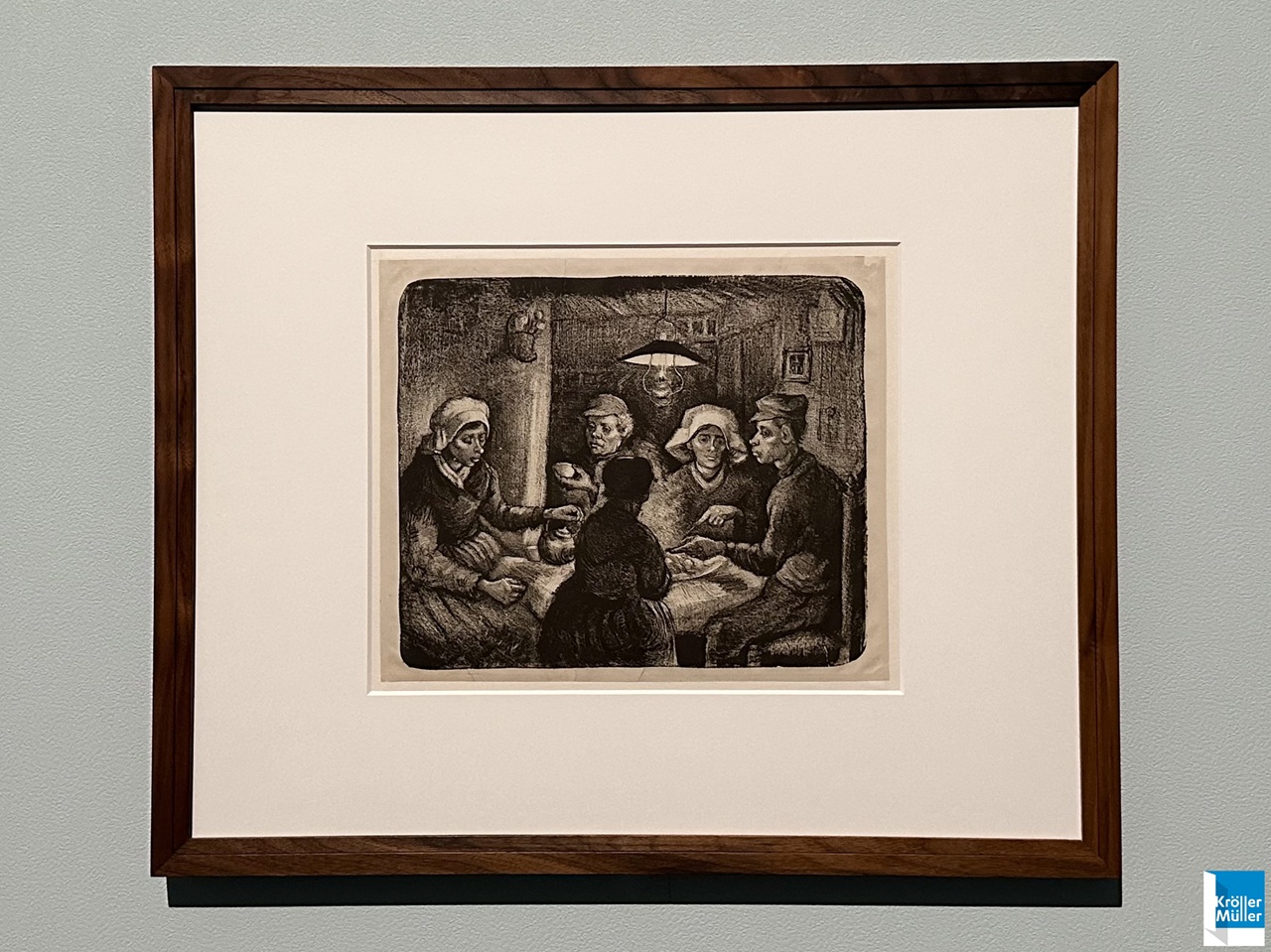
Vincent van Gogh, *The Potato Eaters*, April 1885, Kröller-Müller Museum © Collection Kröller-Müller Museum, Otterlo, the Netherlands.
The culmination of his time in the Netherlands was his oil painting, "The Potato Eaters." The exhibited work is a lithograph based on a study for the oil painting, created to convey to close friends and family the image of his confident work, which tells the story of the nobility of the farmers' "hand labor." Although he had attempted printmaking for the first time, Theo and his friend, the painter Van Labbarde, gave it harsh reviews, calling it "unclear" and "superficial." From this point onward, Van Gogh's inclination towards lyrical expression over technical skill in his art deepened.
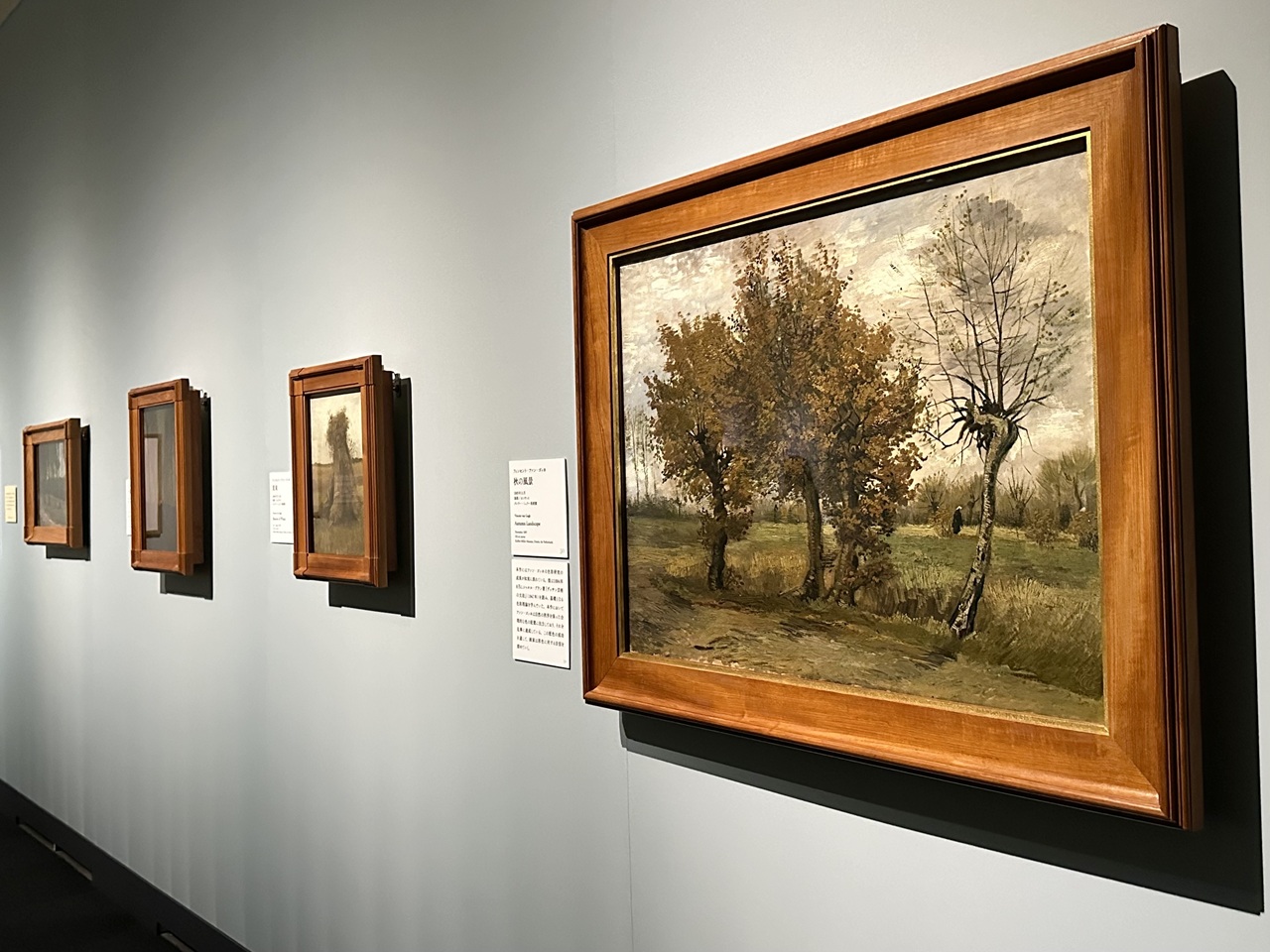
Exhibition view; on the right is Vincent van Gogh's "Autumn Landscape," November 1885, Kröller-Müller Museum.
Chapter 3: "Parisian Painters and Van Gogh"
Chapter 3 focuses on the works of masters, primarily Impressionists, who were active from the 1860s to the 1890s.
Van Gogh, having been criticized by Theo, a successful art dealer in Paris, for the darkness of his paintings and persuaded that he needed to learn more about modern art, and also due to his growing interest in the Barbizon School and his longing for French art and the country itself, impulsively moved to Paris in February 1886 after a short period of study at the art school in Antwerp, Belgium.
Living with Theo in an apartment and having the opportunity to exhibit his work at the café "Le Tamboulan," he interacted with contemporary painters such as Camille Pissarro, Henri de Toulouse-Lautrec, and Émile Bernard. By being exposed to the latest artistic expressions, his art underwent a dramatic transformation, moving away from the dark period of his time in the Netherlands and becoming filled with light and color.
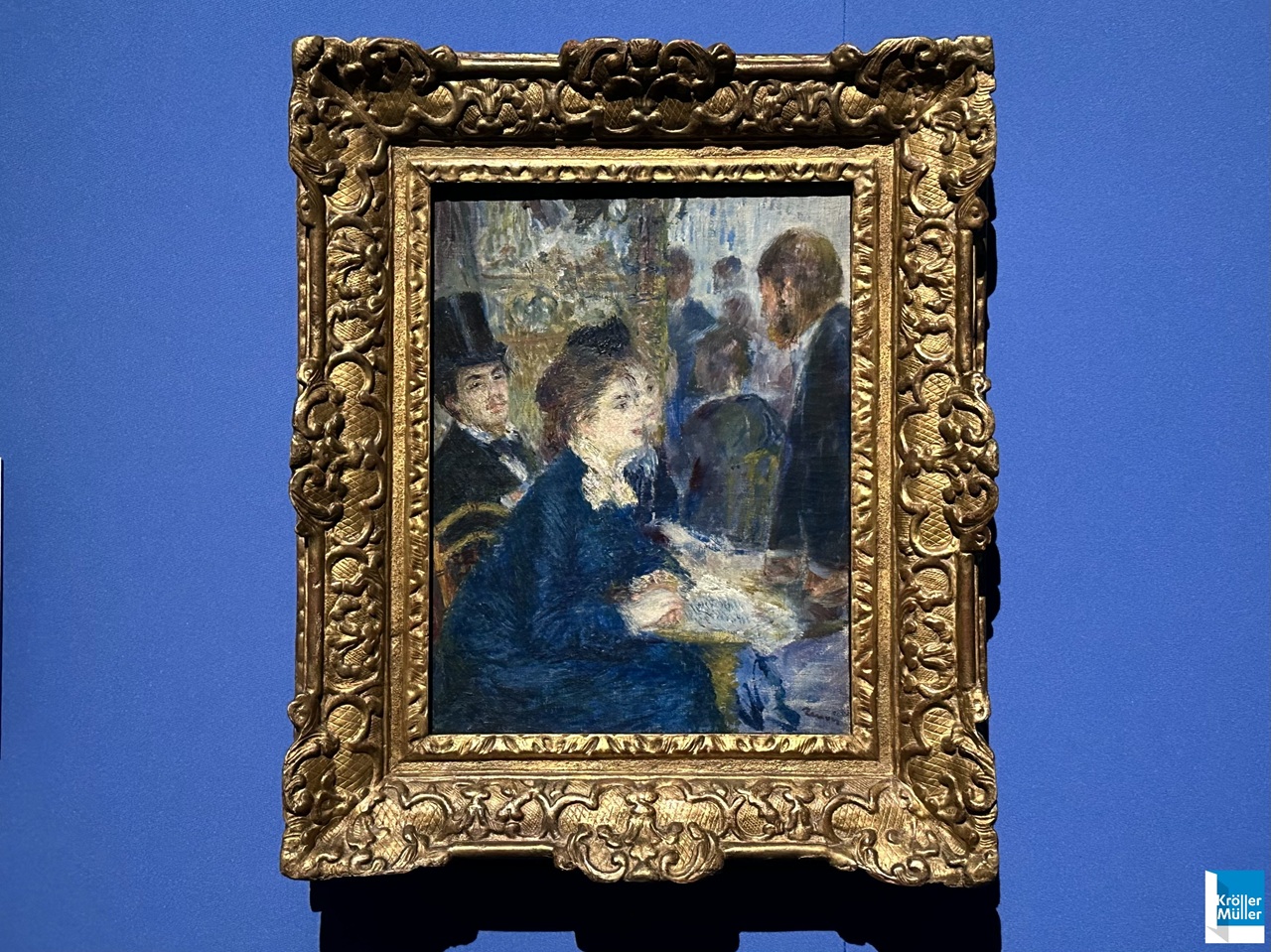
Pierre-Auguste Renoir, *At the Café*, circa 1877, Kröller-Müller Museum © Collection Kröller-Müller Museum, Otterlo, the Netherlands.
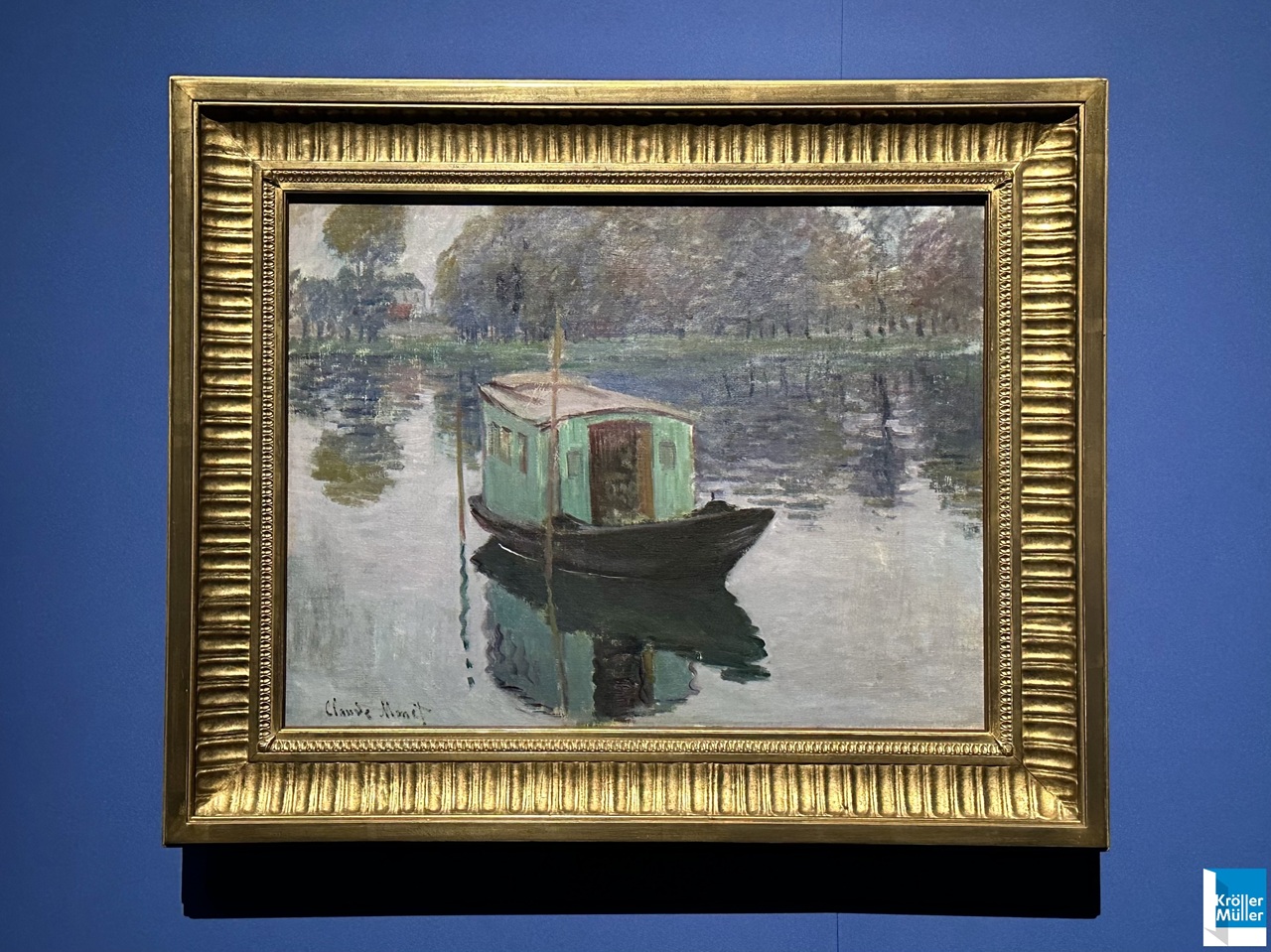
Claude Monet, *Monet's Studio Boat*, 1874, Kröller-Müller Museum © Collection Kröller-Müller Museum, Otterlo, the Netherlands.
Van Gogh was particularly interested in Claude Monet's sense of color, Pierre-Auguste Renoir's vibrant shading and soft brushstrokes, and Paul Cézanne's bold techniques of composition and color expression. He also befriended Neo-Impressionist painters such as Georges Seurat and Paul Signac, and was influenced by them to practice pointillism. By the end of the summer of 1887, he had completed works using a rhythmic brushwork that was his own interpretation of Neo-Impressionism.
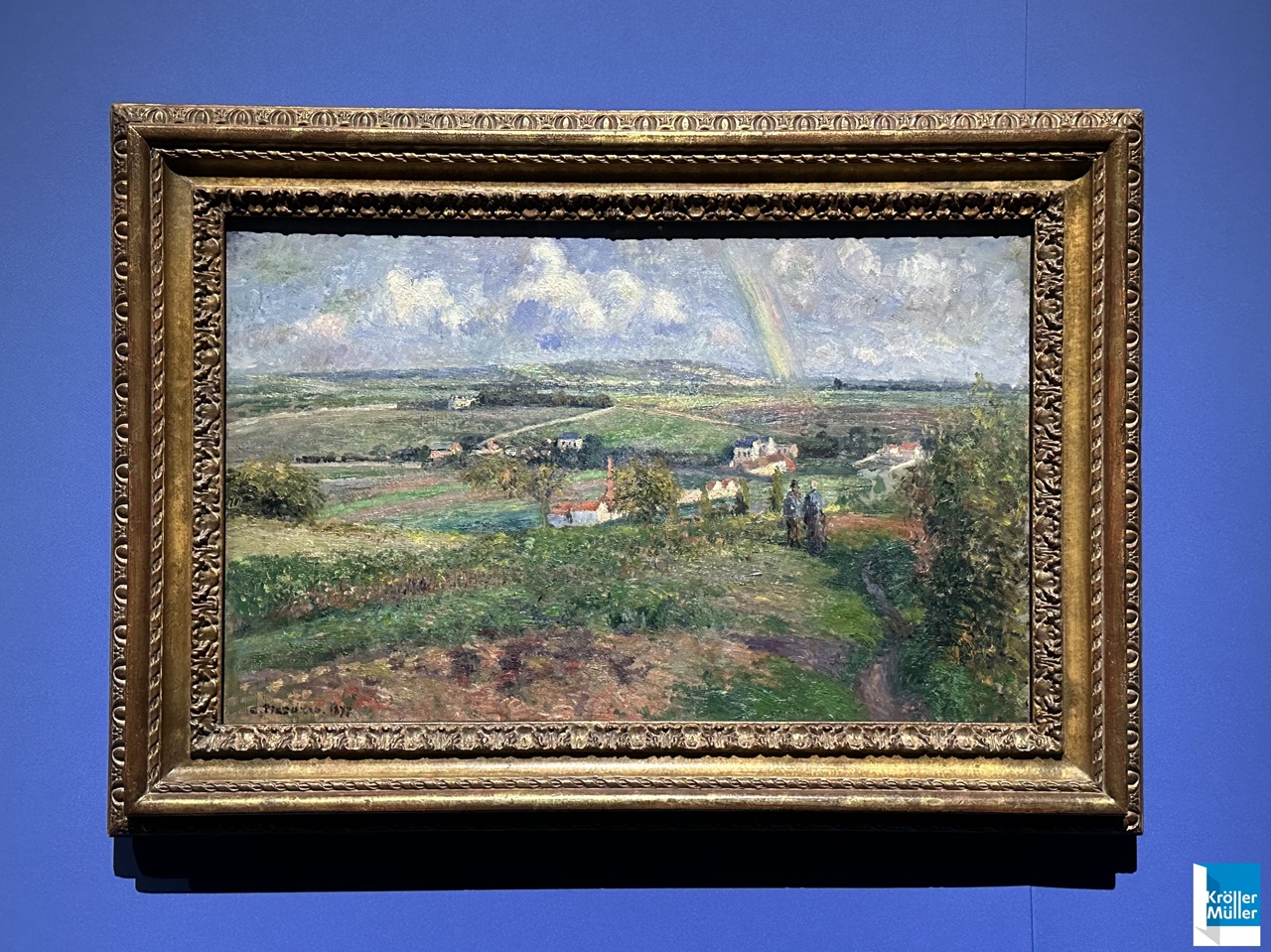
Camille Pissarro, *The Rainbow, Pontoise*, 1877, Kröller-Müller Museum © Collection Kröller-Müller Museum, Otterlo, the Netherlands.
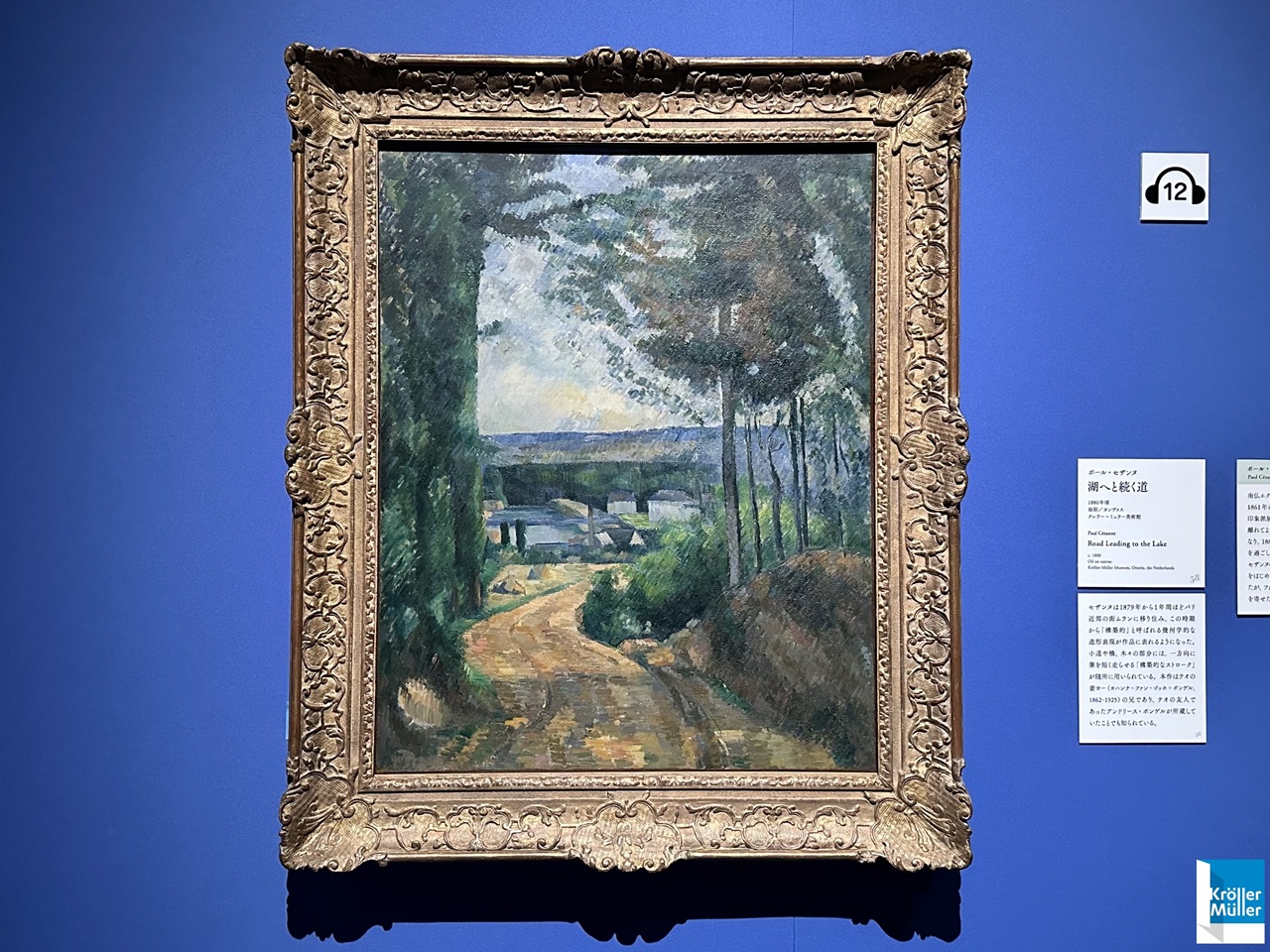
Paul Cézanne, *The Road to the Lake*, circa 1880, Kröller-Müller Museum © Collection Kröller-Müller Museum, Otterlo, the Netherlands.
Around the same time, Maximilian Luce, a Neo-Impressionist painter, practiced pointillism in a more systematic way. Attracted by the beauty of the coexistence of man-made objects and nature, he, like Van Gogh, established his studio on Montmartre Hill, where urban and rural landscapes intersect. His work "Paris Area, View from Montmartre" (c. 1887) captures the view of the industrial area of Saint-Denis from his studio. The lush greenery shining in the summer sun, and the way the smoke rising from the rows of chimneys mixes with the clouds, are vividly depicted using pointillism.
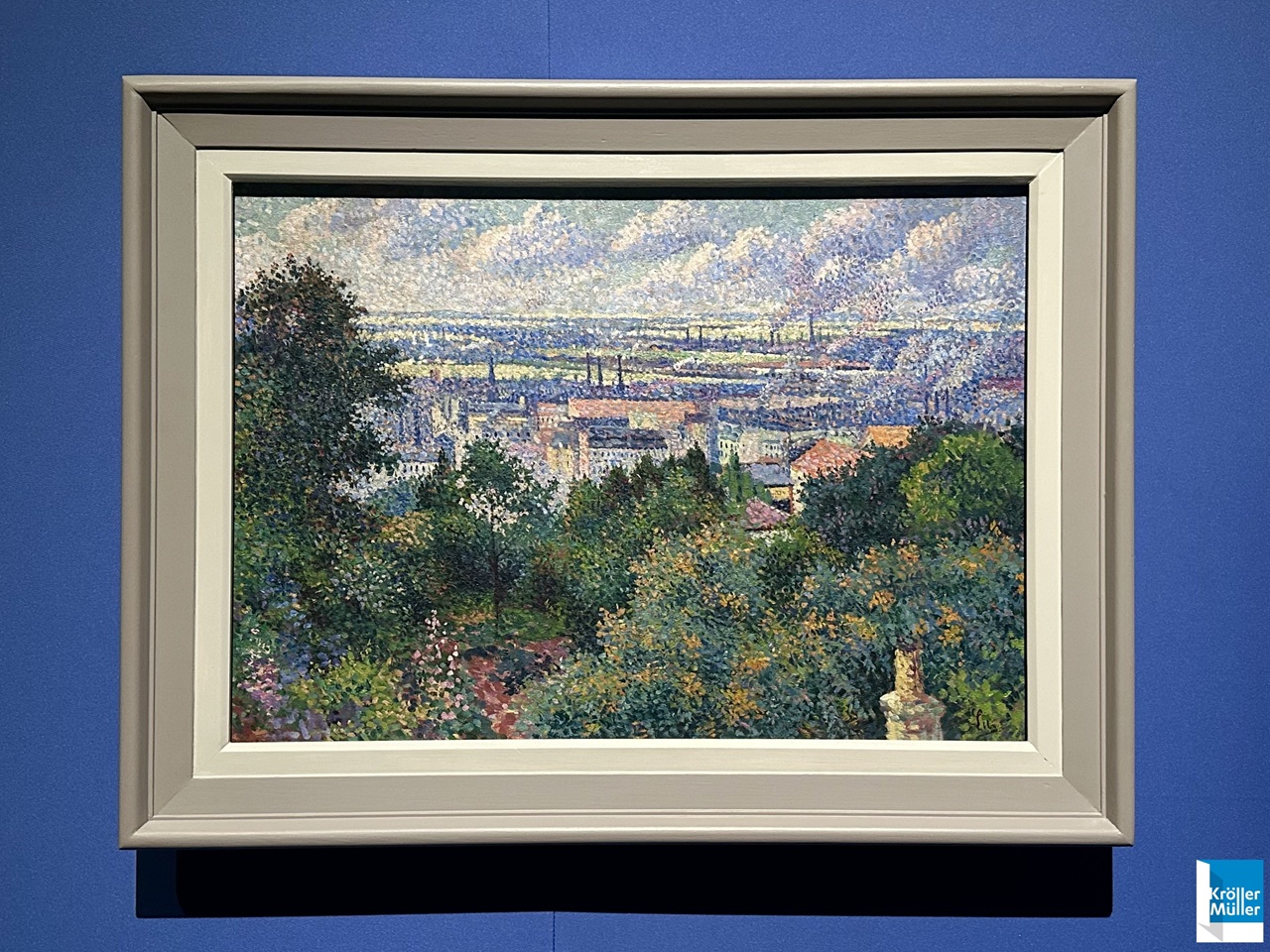
Maximilian Luce, *Paris Area, View from Montmartre*, circa 1887, Kröller-Müller Museum © Collection Kröller-Müller Museum, Otterlo, the Netherlands.
Luce, faithful to Seurat's optical theory, attempted to capture the light and atmosphere of Paris through meticulous and regular pointillism. In contrast, Van Gogh not merely followed the rules of painting, but elevated it to a rhythmic and powerful brushstroke that seemed to pour out his own emotions, and a subjective approach to color.
Chapter 4: "The Paris Period"
Chapter 4 traces the dramatic changes in Van Gogh's painting style during his approximately two years living in Paris.
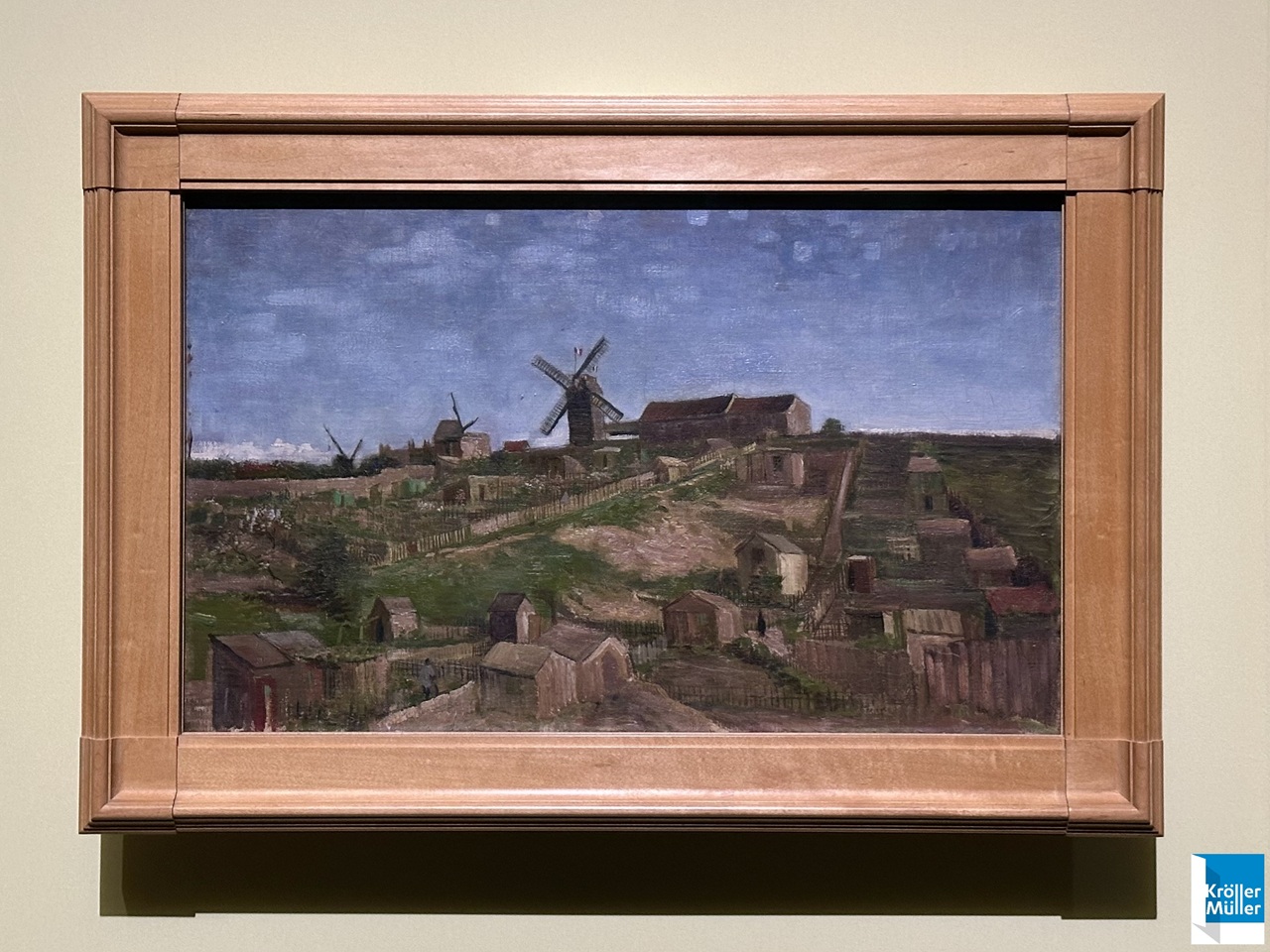
Vincent van Gogh, *Montmartre Hill*, April-May 1886, Kröller-Müller Museum © Collection Kröller-Müller Museum, Otterlo, the Netherlands.
After moving to Paris, Van Gogh was unable to afford models and was forced to paint still lifes and self-portraits instead of the portraits he had wanted to paint. However, this ultimately led to a dramatic improvement in his sense of color.
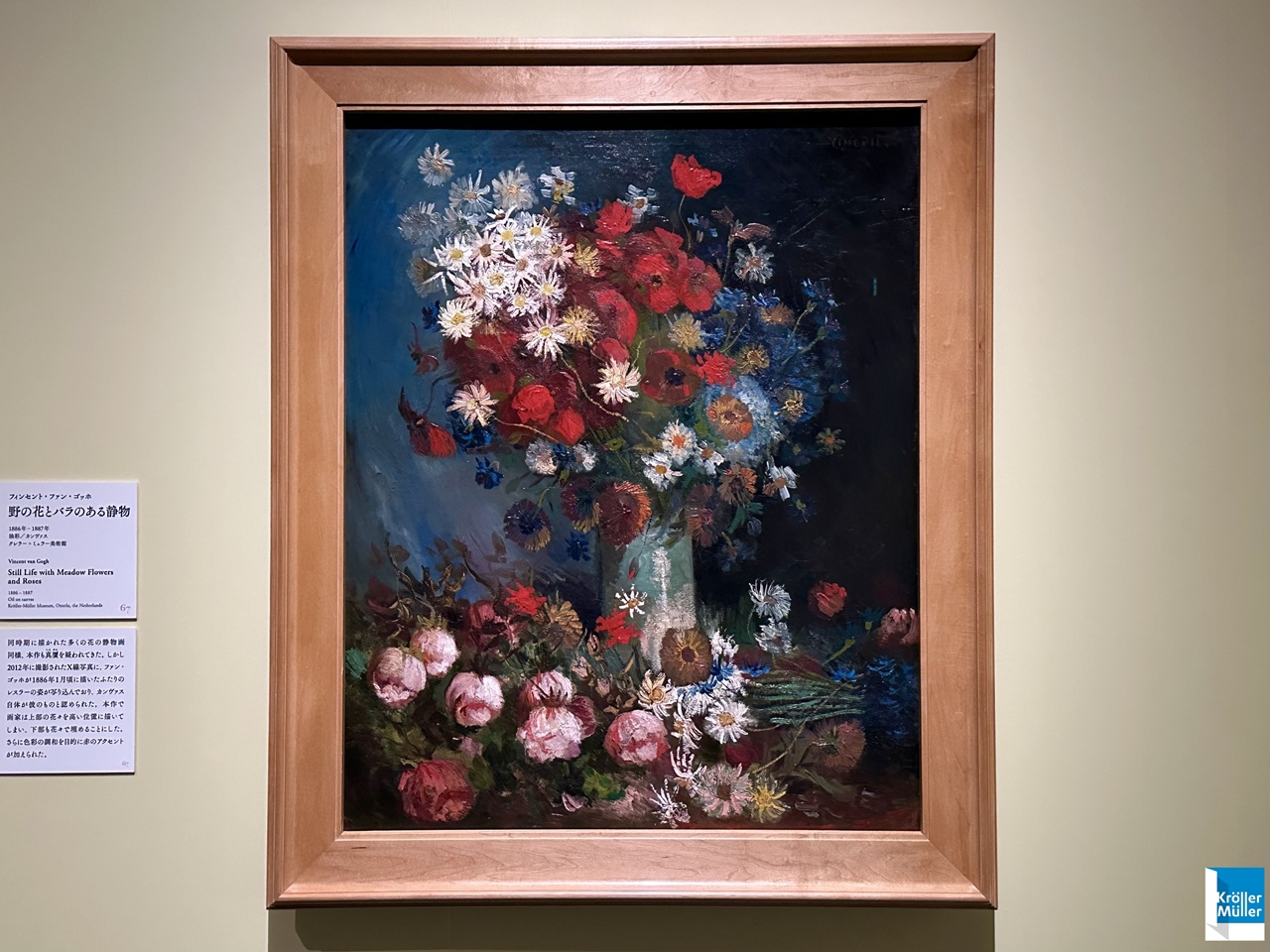
Vincent van Gogh, *Still Life with Wildflowers and Roses*, 1886–1887, Kröller-Müller Museum © Collection Kröller-Müller Museum, Otterlo, the Netherlands.
In particular, at least 30 still lifes of flowers were produced in the summer of 1886 alone. Specifically, he repeatedly experimented with complementary color contrast, placing complementary colors (colors located directly opposite each other on the color wheel), such as red and green, or orange and blue, next to each other to make each color stand out more vividly. Looking at the three exhibited still lifes of flowers— "Roses and Peonies" (1886), "Still Life with Wildflowers and Roses" (1886-87), and "Flowers in a Blue Vase" (1887)—in the order in which they were created, we can see that while the color contrasts intensify, the harmony of the picture becomes more refined, demonstrating his growing mastery of the technique.
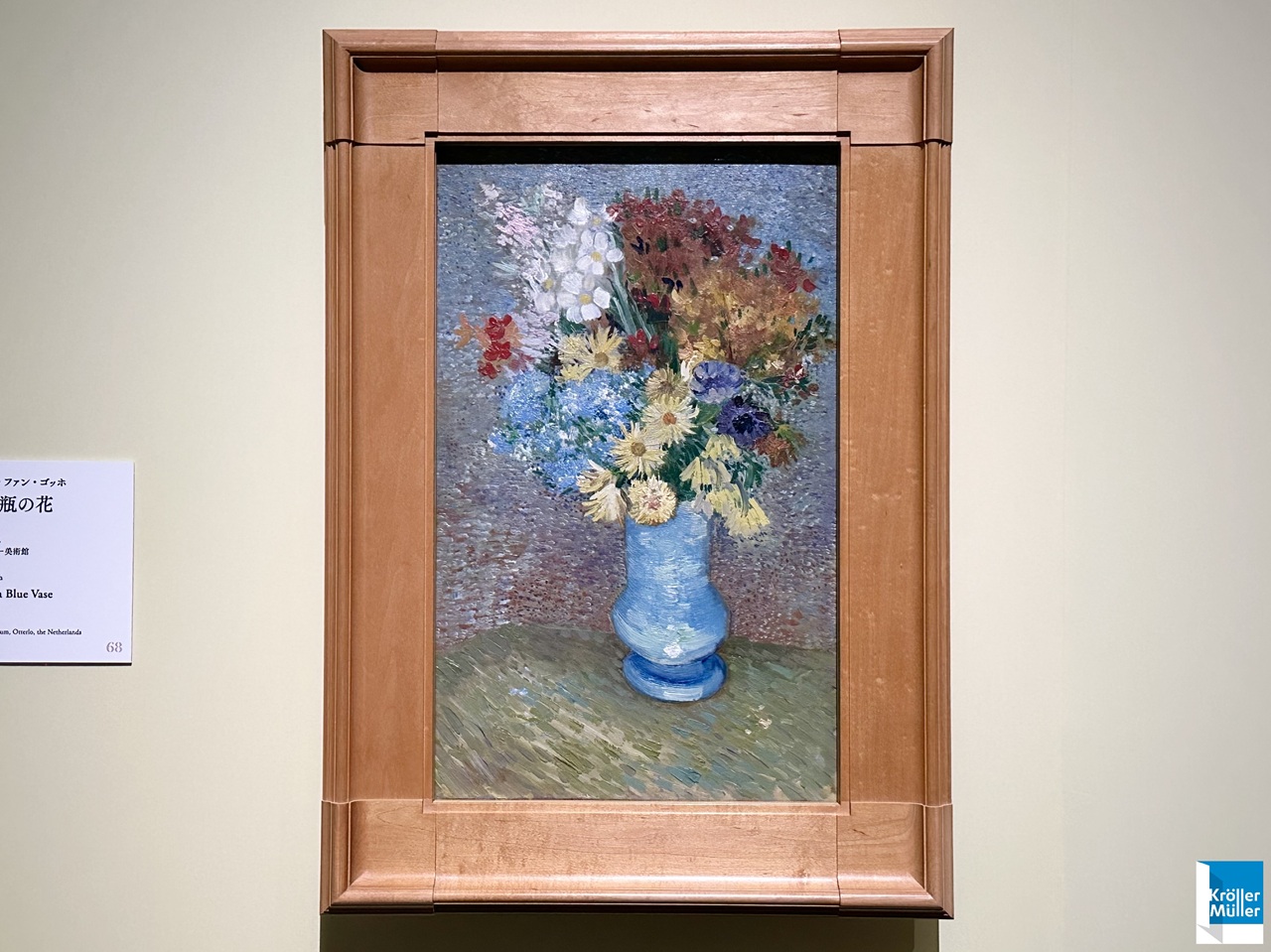
Vincent van Gogh, *Flowers in a Blue Vase*, circa June 1887, Kröller-Müller Museum © Collection Kröller-Müller Museum, Otterlo, the Netherlands.
This was influenced by Eugène Delacroix, who theoretically analyzed and applied the complementary color effect before Impressionism, and by Adolphe Monticelli, whom Van Gogh deeply admired at the time. Monticelli was a painter from southern France known for his original style, which made extensive use of extremely thick paint application reminiscent of sculpture and strong contrasts in color. In addition, his influence from Ukiyo-e prints, including those by Utagawa Hiroshige, was one of the important factors that shaped what is known as Van Gogh's distinctive brushwork and sense of color.
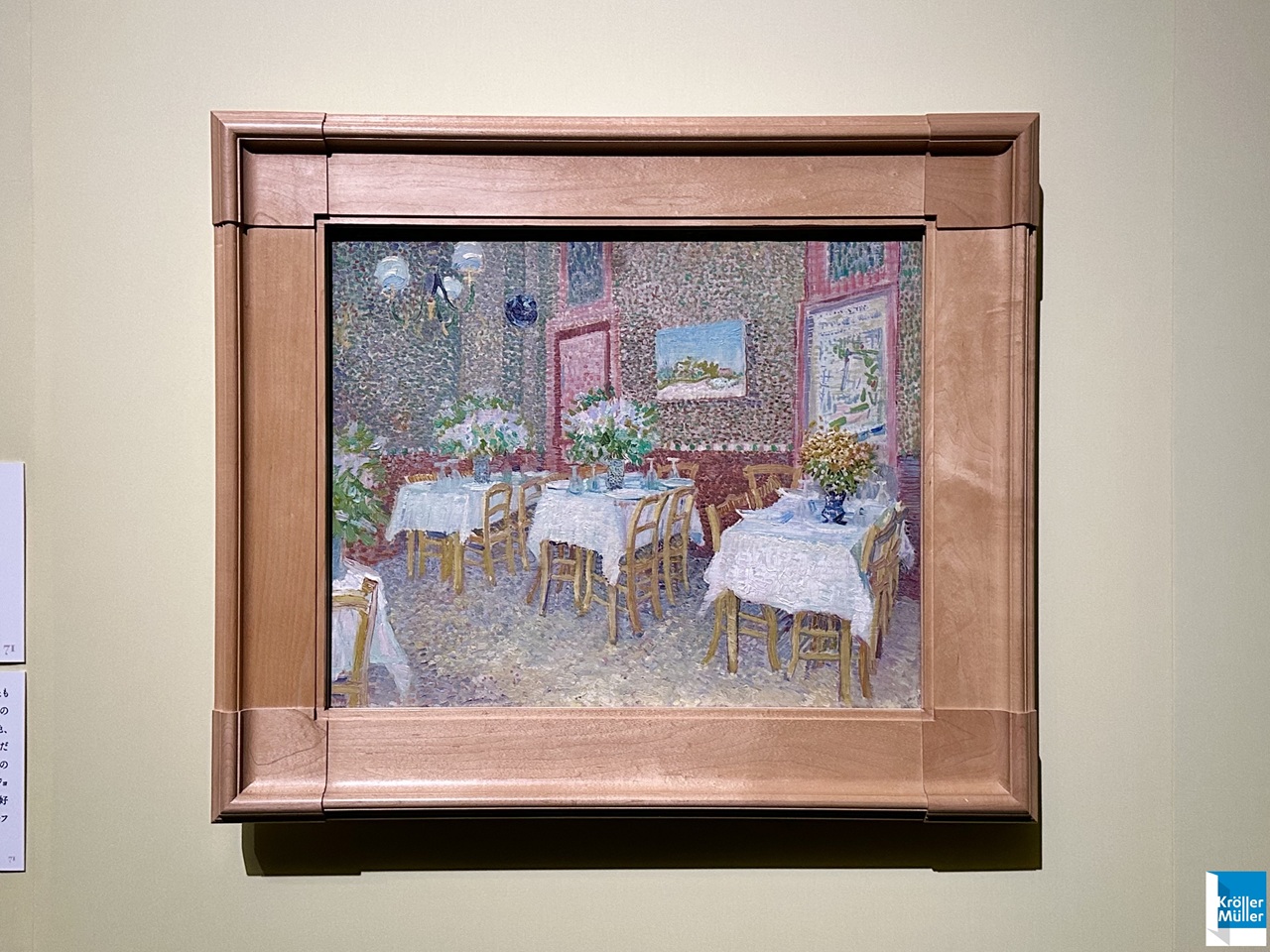
Vincent van Gogh, *Interior of a Restaurant*, Summer 1887, Kröller-Müller Museum © Collection Kröller-Müller Museum, Otterlo, the Netherlands.
Unusually for Van Gogh, "Restaurant Interior" (1887), set in a restaurant catering to the bourgeoisie, is one of the works that most clearly demonstrates the Neo-Impressionist technique. Using pointillist brushstrokes reminiscent of Signac, he arranges complementary color contrasts—the red and green of the wall, the yellow and muted purple of the floor, and the orange of the chairs and the bluish of the tablecloth—with a balance that reveals careful consideration.
However, the table and chairs are not always rendered with thorough pointillism. In addition, this work was painted on the reverse side of a canvas that had been used before, and perhaps the meticulous dotting technique was too restrictive for the painter's passionate temperament, as he distanced himself from strict pointillism after moving to Arles. This work is particularly popular among Van Gogh's works for its bright and refined colors, but considering these points, it may not have been something he wanted to widely showcase, but rather merely an opportunity to acquire technical skills.
Chapter 5: "The Arles Era"
While Van Gogh achieved great success as a painter in Paris, the hustle and bustle of the city and the fierce competition among artists gradually took a toll on his mind and body. Seeking the dazzling sunlight seen in his beloved Ukiyo-e prints and the ideal community of artists working together, he moved to Arles, a small town in southern France, in February 1888. He was completely captivated by the vibrant colors and abundant sunshine, and became engrossed in expressing nature through vivid color contrasts.
In less than 15 months, he produced approximately 200 oil paintings and over 100 drawings and watercolors. Simultaneously, he conceived the "Yellow House," a communal studio, and prepared to invite many up-and-coming artists, including Paul Gauguin.
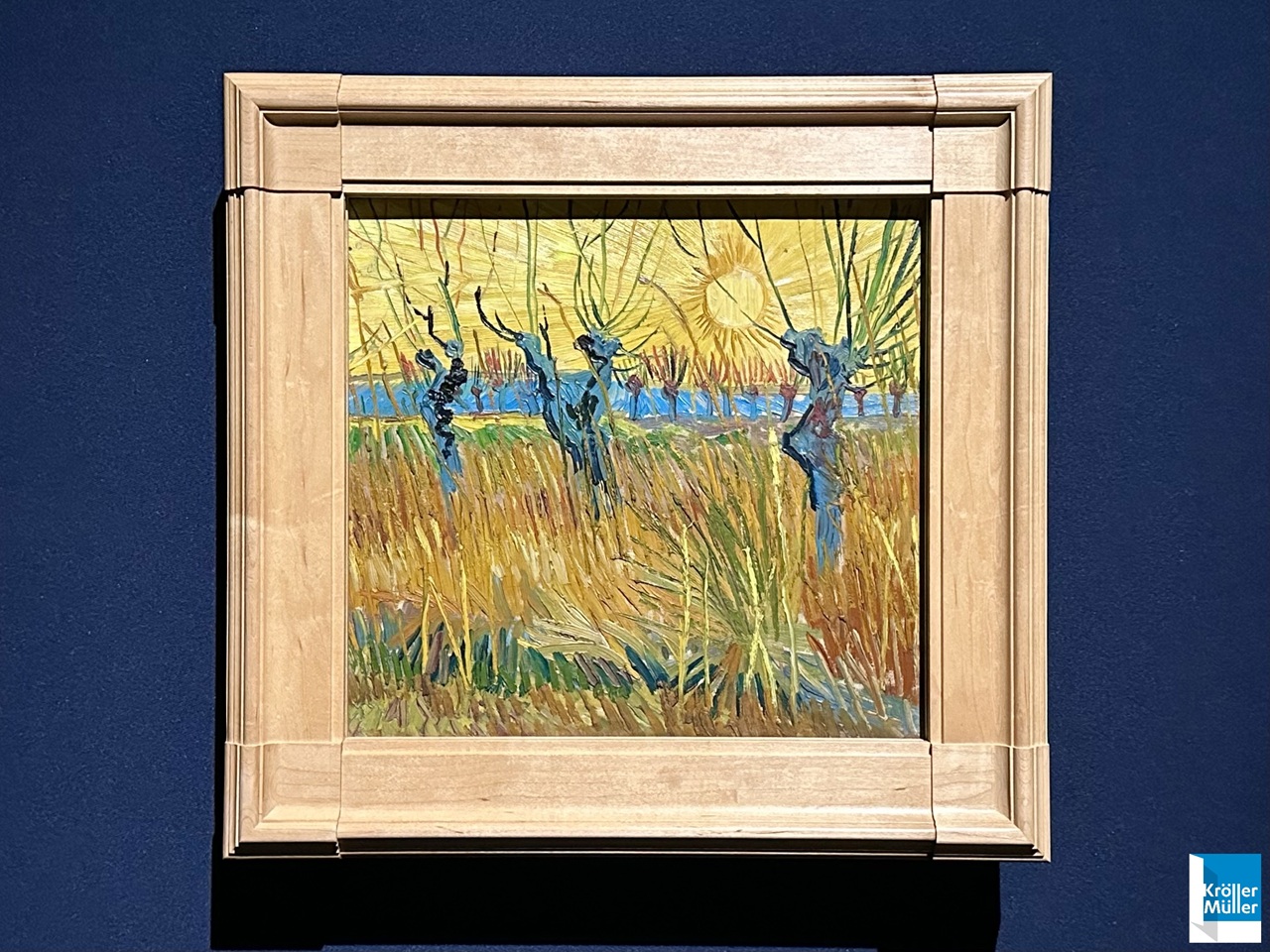
Vincent van Gogh, *Trimmed Willows at Sunset*, March 1888, Kröller-Müller Museum © Collection Kröller-Müller Museum, Otterlo, the Netherlands.
As evidenced by his words, "What I absolutely want to paint now is the starry sky," and "To me, the night often appears far more vibrant and colorful than the daytime," it wasn't just the daytime light that uplifted Van Gogh in Arles.
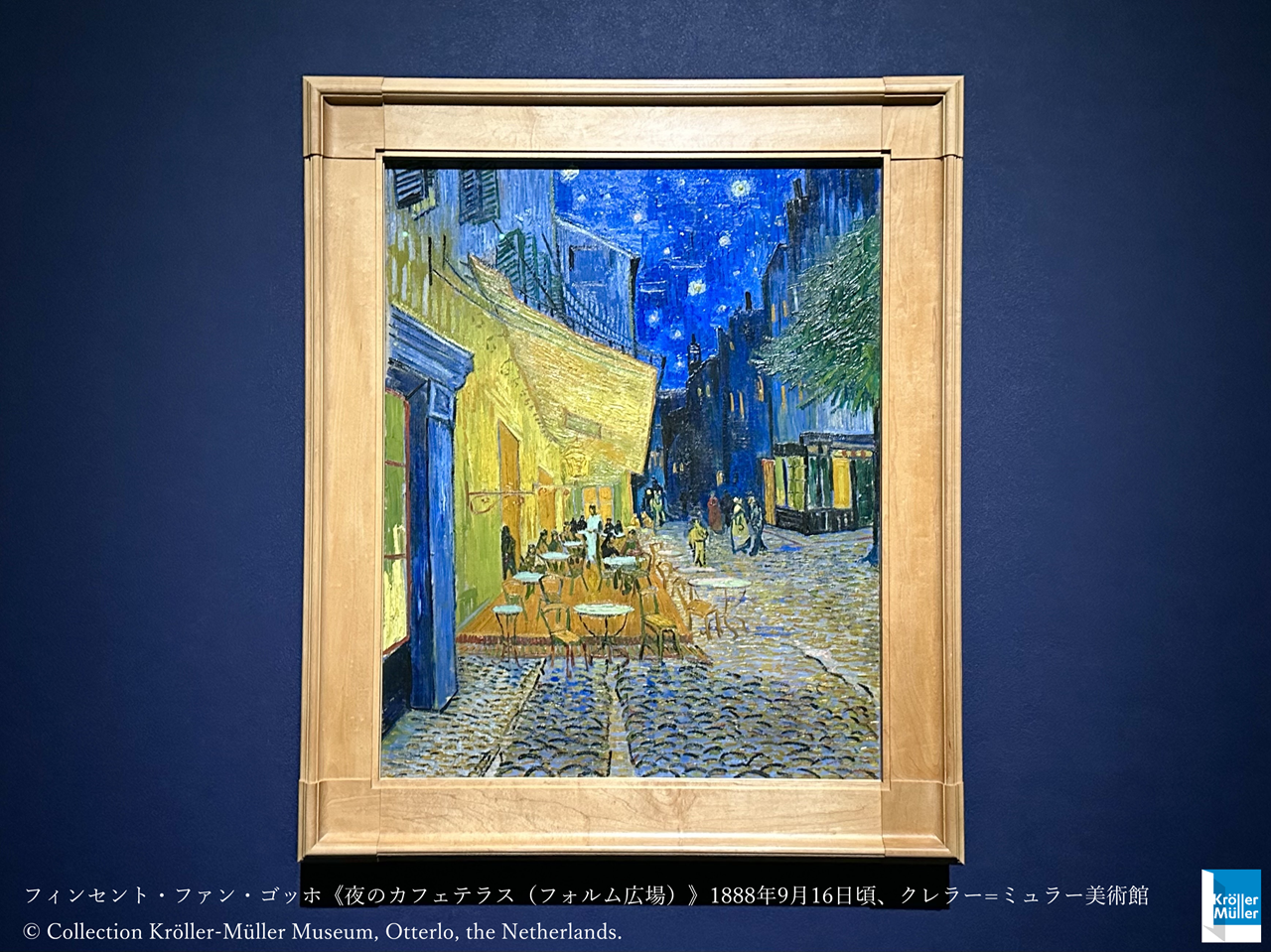
The highlight of this exhibition , "Café Terrace at Night (Place du Forum)" (1888), depicts the nighttime scene of Place du Forum in the heart of the city, bathed in the yellow light of gas lamps. It is one of Van Gogh's finest masterpieces, rarely seen outside of the Netherlands, and is a monumental work in which he first depicted a starry sky in a truly remarkable way.
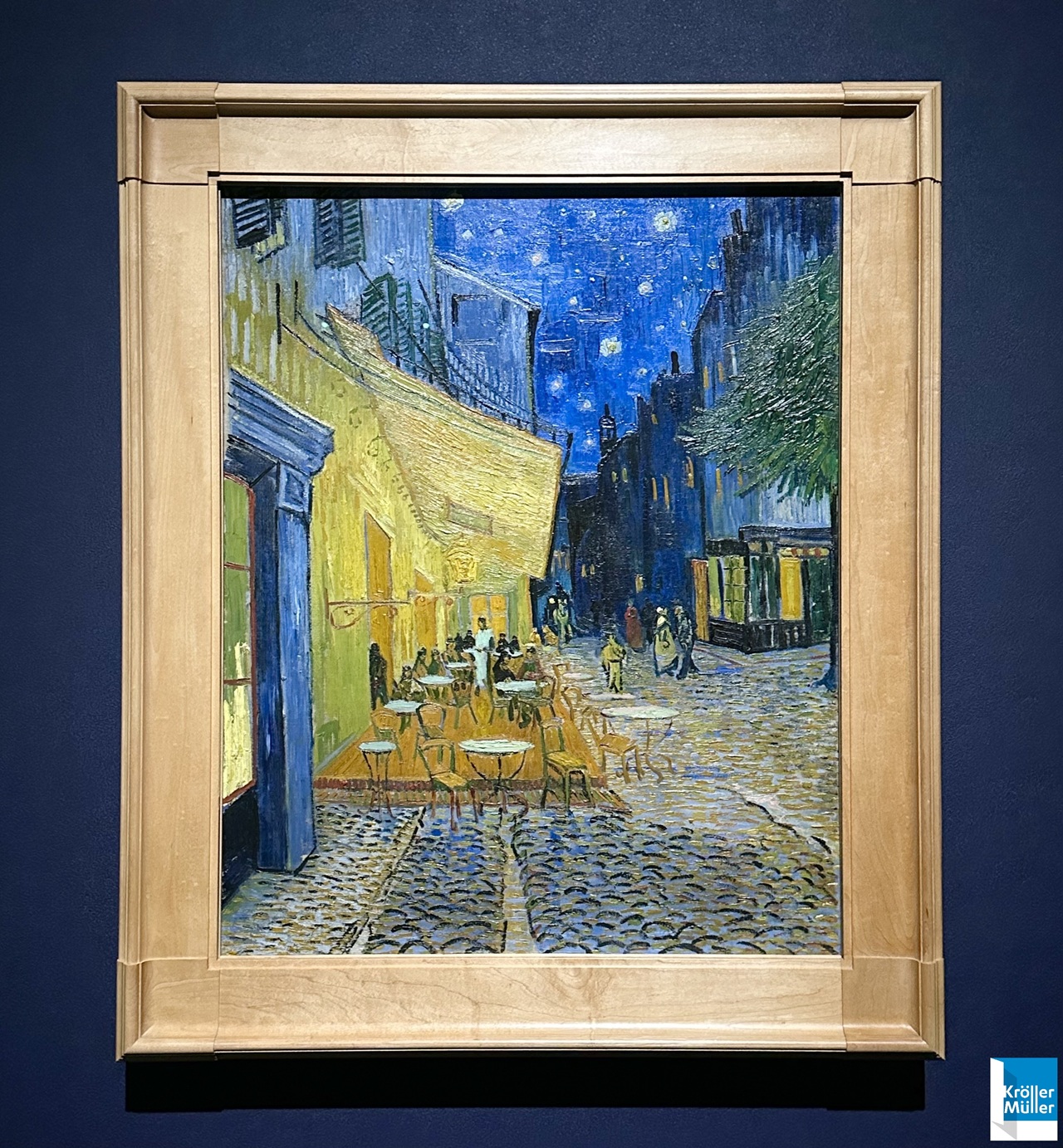
Vincent van Gogh, *Café Terrace at Night (Place du Forum)*, circa September 16, 1888, Kröller-Müller Museum © Collection Kröller-Müller Museum, Otterlo, the Netherlands.
Against a backdrop of a star-filled night sky, a café terrace shines brightly. The raised paint of the stars gives them a presence like jewels. Regarding this work, Van Gogh wrote in a letter, "This is a painting of the night without black. There are only beautiful blues, purples, and greens, and against this backdrop, the illuminated square is colored in pale sulfur and greenish lemon yellow." The contrast between the warm-colored foreground and the cool-colored background gives it an eye-catching brilliance, redefining the image of night which had often been depicted in black and gray in traditional Western painting.
It has been suggested that Van Gogh's pursuit of the starry sky was influenced by the magnificent descriptions of the night sky in Guy de Maupassant's novel "Bel-Ami," which he loved to read, as well as the colorful starry sky he saw in the Mediterranean Sea in early June 1888. In any case, what is important is that for him, the starry sky was an important motif that represented "hope."
It is thought that when this work was created, the community members were filled with anxiety and loneliness, unsure whether their friends would come to visit, but also with excitement and hope. A letter remains that says something to the effect of, "When I feel restless at night, I go outside and look at the sky, and the stars look like my friends," suggesting that in this work as well, the characters may have been associating the stars with the images of their friends.
However, it's worth noting that cafes at that time were different from those of today, serving as places for socializing and indulging in pleasure. The depiction of the cafe terrace in this work is known to be a conscious reference to the scene in "Bel Ami" mentioned earlier, where the poor protagonist gazes with disgust at a night cafe where wealthy people enjoy food and drink and prostitutes hang out. Furthermore, regarding "The Night Cafe," a work created around the same time, Van Gogh stated that he "tried to express that a cafe is a place where people ruin themselves, lose their sanity, and commit crimes."
The earthly world, where desire and decadence intertwine, and the heavenly world, where starry skies symbolize hope. Van Gogh contrasted these two worlds, and perhaps through the vivid contrast of complementary colors, he tried to further highlight the brilliance of the latter.
The second phase of the exhibition, "The Great Van Gogh Exhibition: The Langlois Bridge at Arles," is scheduled to tour from Kobe on February 6, 2027, to Fukushima and Tokyo. The Langlois Bridge at Arles, considered a Dutch national treasure, will be exhibited in Japan for the first time in approximately 70 years, so be sure to check it out.
■ Overview of "The Great Van Gogh Exhibition: Cafe Terrace at Night"
Date: May 29, 2026 (Friday) – August 12, 2026 (Wednesday)
Venue: Ueno Royal Museum
Opening hours: Sunday to Thursday 9:00-17:30 / Friday, Saturday, and public holidays 9:00-19:00
*Entry is permitted until 30 minutes before closing time.
Closed days: Open every day during the exhibition period.
Admission fees (weekdays): General admission 2,800 yen, University/vocational school/high school students 1,600 yen, Junior high/elementary school students 1,000 yen
*An additional 200 yen will be charged on Saturdays, Sundays, and public holidays.
*Admission is free for high school students and younger until June 30th (Tuesday).
*Please check the official website for details.
Organizers: Sankei Shimbun, TBS, TBS Growdia, Hakuhodo, Ueno Royal Museum
For inquiries: 050-5541-8600 (Hello Dial / 9:00 AM – 8:00 PM)
Exhibition official website | https://grand-van-gogh-tokyo.com/
*The information in this article is current as of the time of the interview. It may differ from the latest information, so please check the official website for details.
